


PMP 2026 Official Reference List: Build a Study Source Map Without Reading Everything
A practical PMP 2026 study-source map that connects current exam tasks to authoritative references and scenario-practice evidence without requiring every source to be read cover to cover.
An official reference list can make a PMP study plan feel more certain. It can also make the plan much larger than it needs to be.
The mistake is to treat every listed publication as a book that must be read from the first page to the last. PMI does not describe its current PMP reference list that way. Its exam-preparation page says the Exam Content Outline is the best way to understand what the exam covers and how it is structured. The same page describes the listed references as sources frequently cited by the volunteer professionals who develop exam questions, and it says the list is provided as a courtesy.
That distinction should change how you study.
Start with the current exam task, not with a stack of books. Select a source because it helps you understand that task. Then test the idea in a realistic scenario and record what the practice exposed. When another source would only repeat what you already understand, stop expanding the reading list and work on application.
This article gives you a practical way to do that. The method is a PM Structure study-planning tool, not an official PMI requirement and not a promise that using fewer sources will produce a particular exam result.
Why the reference list creates the wrong study question
When candidates see a list of ten references, a natural question is: "How do I finish all of these?"
That is usually the wrong question. It turns preparation into a reading-completion project instead of a capability-building process. A candidate can finish several books and still struggle to decide what to do in a scenario. Another candidate can use a smaller set of sources but fail because the sources were selected for familiarity rather than for a defined gap.
A better question is:
What current exam task am I trying to understand, which authoritative source will help me understand it, and what practice evidence will show whether I can apply it?
This question creates traceability. It gives every source a job. It also gives you a reason to stop reading, change sources, or move into practice.
The need for current traceability is stronger after the July 2026 exam update. PMI's current exam-update page records changes in emphasis and scope. You do not need to repeat every transition detail inside your source map, but you do need to verify that the outline and reference page you are using are current.
What the official pages establish
Three boundaries matter.
First, use the current PMP Exam Content Outline as the coverage anchor. PMI's PMP exam-preparation page directs candidates to the outline to understand what to expect, what is included, and how the exam is structured.
Second, treat the reference list as a source register, not as a mandatory linear syllabus. At the 28 July 2026 review point, the page presented two PMI publications and eight additional publications. PMI also noted that it does not endorse or warrant the accuracy of the non-PMI publications. The list may change, so verify the live page rather than relying on a screenshot, an old course deck, or a third-party summary.
Third, do not infer exam questions from the references. A source can help you understand a concept or decision without revealing how a live exam item will be written. Your preparation should remain ethical and capability-led.
These boundaries lead to a simple operating principle: outline first, source second, practice third.
Build the three-layer PMP source map
 Desktop
 Mobile
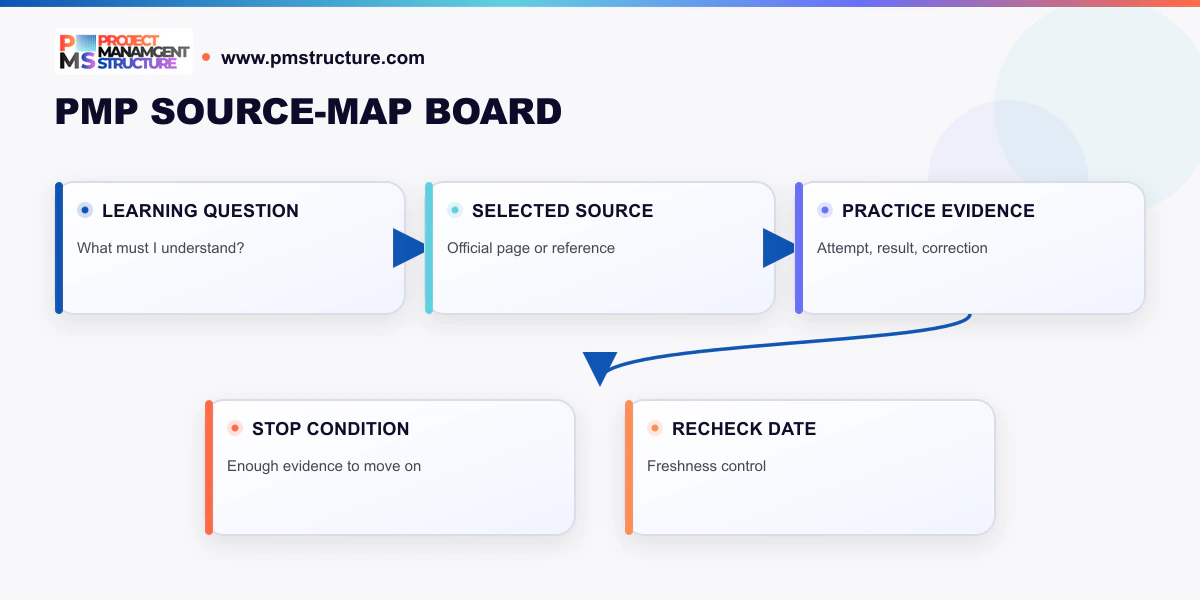
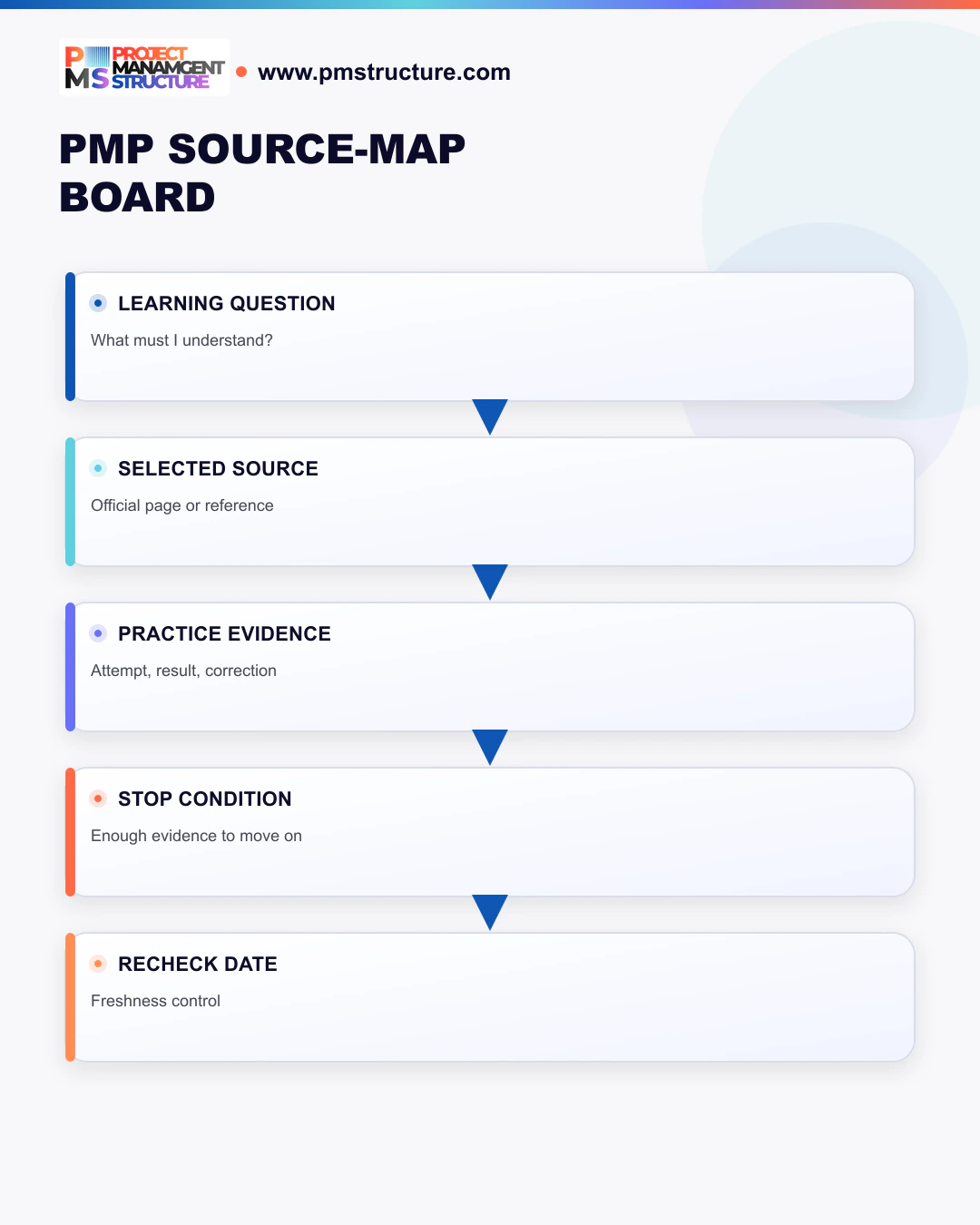
Create one row for each priority task or decision you are working on. The row should contain three connected layers.
| Layer | Question | Evidence to record |
|---|---|---|
| Exam task | What must I be able to understand or decide? | Current outline domain/task, your present confidence, and why it matters now |
| Authoritative source | Which current source best explains this gap? | Source title, relevant section, selection reason, and recheck date |
| Practice evidence | Can I apply the idea in context? | Scenario type, response, rationale, error pattern, correction, and next review |
The table is deliberately small. It prevents a study plan from becoming a library inventory.
Step 1: start with one task, not one book
Open the current outline through PMI's PMP certification route or exam-preparation page. Select one task, capability, or decision where your evidence is weak.
Write the task in plain language. For example:
- evaluate a change request without losing sight of value;
- respond to stakeholder resistance while preserving trust and accountability;
- choose an approach for work with uncertainty;
- connect a project decision to business impact.
Do not begin with "read chapter six." A chapter is a source location, not the capability you are trying to build.
Step 2: write the learning question
Turn the task into a question that a source can answer.
Weak question:
What does this book say?
Stronger question:
What information should a project manager examine before recommending whether a change is accepted, deferred, rejected, or reframed?
The stronger question gives you selection criteria. It also makes it easier to notice when a source is too general, out of date, or duplicative.
Step 3: select the smallest useful source set
Choose a primary source that directly explains the task. Add a second source only when it supplies a different and necessary perspective, such as an agile context, a systems view, a stakeholder lens, or a practical example.
For each source, record:
- the exact title and edition or current web page;
- the section you need;
- the question it is meant to answer;
- why the source is authoritative or useful;
- the date on which you will recheck it.
Do not add a source because it appears in a popular reading list or because someone described it as essential. Add it because it has a defined role in your map.
Step 4: convert reading into practice evidence
Reading creates exposure. It does not by itself show that you can make a decision.
After studying the selected section, work through a scenario that requires the same type of judgment. Record:
- what you believed the central issue was;
- what action you selected;
- why you selected it;
- which evidence or principle supported the decision;
- what an incorrect answer or weak rationale revealed;
- what you will review next.
If you need a repeatable practice rhythm, use a structured scenario-practice operating system rather than collecting disconnected question scores.
The useful evidence is not only whether the answer was correct. A correct choice with a weak reason can hide a gap. A wrong choice with a well-diagnosed error can create a precise next action.
Step 5: add a stop-reading guard
Source expansion should stop when:
- the selected source answers the learning question;
- your practice rationale uses the idea accurately;
- repeated scenarios no longer expose a new conceptual gap; and
- another source would duplicate rather than extend the coverage.
This guard does not mean that one source is always enough. It means every additional source must earn its place.
If practice exposes a different weakness, open a new row. Do not keep stretching the same reading task until it covers everything.
A hypothetical source-map row
Imagine a candidate named Samira who is comfortable with formal change control but repeatedly mishandles scenarios in which a technically valid change could weaken the intended business outcome.
Her first source map is too broad:
| Task | Source | Practice |
|---|---|---|
| Change management | Read two full books | Complete 100 mixed questions |
It contains activity, but little diagnosis.
She rewrites the row:
| Layer | Samira's record |
|---|---|
| Exam task | Evaluate a proposed change by considering value, stakeholder impact, delivery constraints, and the appropriate decision route |
| Learning question | What should be assessed before recommending the next action on a change? |
| Source | Current official reference section selected for integrated change and value decision-making; second source added only for adaptive-context treatment |
| Practice evidence | Five targeted scenarios; record decision, rationale, missed signal, and correction |
| Stop condition | Stop adding sources when the rationale consistently connects the change to value, impact, and governance rather than to process compliance alone |
| Recheck | Confirm the outline and reference page are still current before the next study cycle |
This example does not prove that Samira is exam-ready. It shows how a vague reading plan can become a traceable learning decision.
Use the map as a weekly control
Review the map once a week. Keep the review short.
Ask:
- Which task exposed the most consequential error this week?
- Is the problem missing knowledge, misapplied knowledge, weak reading of the scenario, or an unsupported assumption?
- Does the current source address that problem?
- What targeted practice will test the correction?
- Should a source be retained, replaced, narrowed, or closed?
This review keeps the plan responsive without allowing it to change after every difficult question.
Use simple states:
- Open: the task and source are selected, but practice evidence is incomplete.
- Test: targeted scenarios are being used to evaluate application.
- Review: an error pattern requires source or reasoning correction.
- Closed for now: the current evidence is sufficient to move attention elsewhere.
- Revalidate: the outline, reference page, or source version needs a current check.
"Closed for now" is not a claim of mastery. It is a bounded study decision.
Common mistakes
Mistake 1: reading the reference list in order
The order of a list does not establish the sequence in which you should learn. Let the current task and your evidence determine the sequence.
Mistake 2: using one source for every problem
A familiar book can become a comfort zone. If it cannot answer the learning question, choose a more direct source.
Mistake 3: adding sources after every wrong answer
Some errors come from reading the scenario poorly, ignoring a constraint, or choosing an action before diagnosing the situation. Diagnose the error before expanding the reading list.
Mistake 4: treating a correct answer as complete evidence
Record the rationale. If you cannot explain why the chosen action fits the context and why a tempting alternative is weaker, the correct result may not be stable.
Mistake 5: freezing the map for the entire preparation period
PMI pages and source editions can change. Keep a recheck date and confirm the current outline and reference page before a major study-plan decision or final review.
Mistake 6: converting a courtesy list into an endorsement
PMI explicitly distinguishes its reference list from endorsement of non-PMI publications. Describe each source accurately and do not borrow authority that the source page does not grant.
Frequently asked questions
Do I need to read every book on the PMP reference list?
PMI's current page describes the list as sources cited in exam-question development and provides it as a courtesy. It does not state that every item must be read cover to cover. Build your plan from the current outline and your diagnosed learning needs.
What should lead a PMP study plan?
Use the current Exam Content Outline to identify coverage and tasks. Then select sources and practice that serve those tasks.
How many sources should I use for one task?
There is no responsible universal number in the official sources reviewed here. Start with the most direct current source and add another only when it contributes a necessary perspective or resolves a gap.
When should I stop adding study material?
Stop when the selected source answers the learning question, your practice rationale applies the idea accurately, and another source would only duplicate coverage. Reopen the row if later practice reveals a new gap.
Does this source map guarantee PMP readiness?
No. It is an independent PM Structure planning method. It helps make study decisions traceable, but it does not predict exam questions, PMI decisions, or an exam outcome.
Next action
Choose one current outline task that is causing repeated uncertainty. Create one row with the task, one learning question, one selected source, one targeted practice set, and one stop condition. Review the row after practice before you add another book.
If you want a structured route from source selection to practice and review, build your PMP study path. PM Structure provides independent preparation and readiness support; it does not issue the PMP credential, disclose exam questions, or guarantee an exam result.
References
- Project Management Institute. PMP Exam Preparation and Reference List. Accessed 28 July 2026.
- Project Management Institute. New PMP Examination. Accessed 28 July 2026.
- Project Management Institute. Project Management Professional (PMP). Accessed 28 July 2026.

PM Structure Editorial Role
PMP Readiness MentorA PM Structure editorial role providing source-reviewed guidance on PMP readiness, exam preparation, and study planning.
View all articles by PMP Readiness MentorThis article is editorial content from PM Structure. It does not replace official certification-body guidance. For pathway and readiness support, explore certifications.
Related Articles

Hybrid Governance for GCC Transformation Portfolios: Fix the Interfaces, Not the Labels

Before You Book Live PMP Training: What PMI’s Late-Q4-2026 Eligibility Change Means
Build a PMP Scenario Practice Operating System, Not a Question Habit

From Site Work to Verifiable Project Leadership: PMP Application Stories for GCC Engineers
Stay ahead of the curve
Get weekly insights on certification strategy, agile leadership, and career growth.
View all articles