


CAPM 23 Hours: Build an Audit-Ready Education Evidence Plan
Separate CAPM education evidence from study time and organize provider, course, hours, completion and application records before applying.
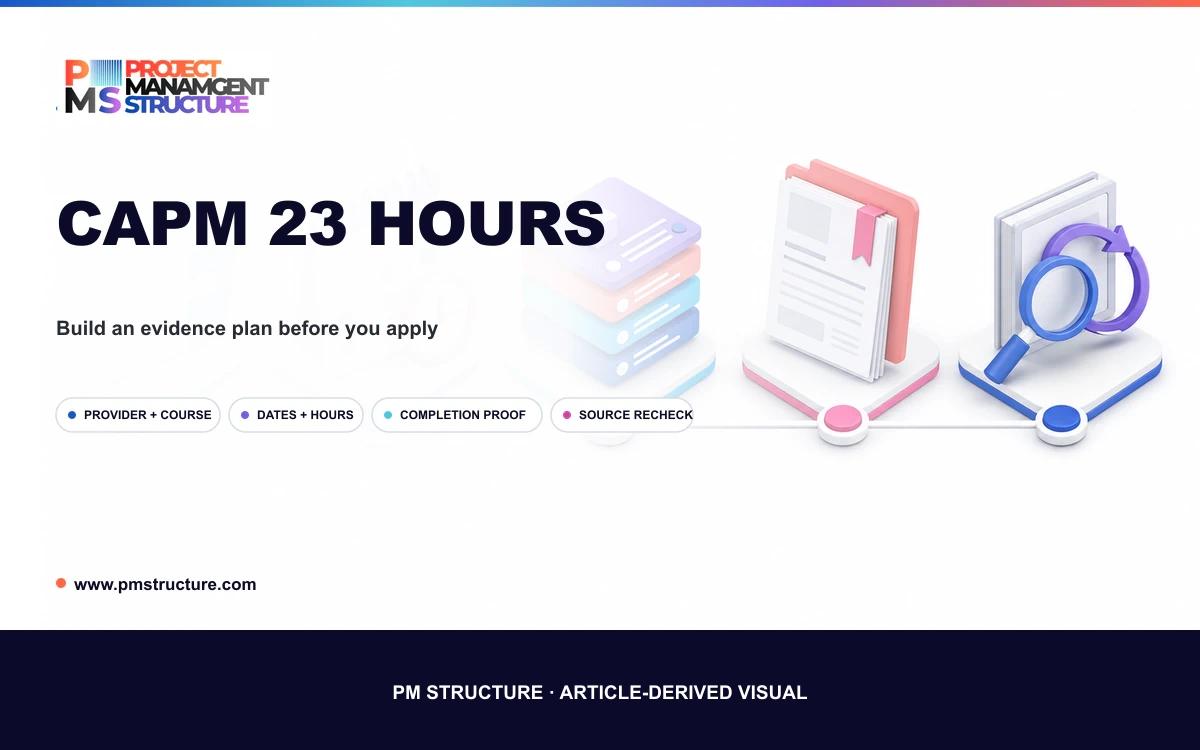
The number 23 answers one specific question. It does not answer every question about CAPM preparation.
PMI’s current CAPM eligibility page requires at least 23 hours of project-management education completed before the exam. That is an education condition. It is not a universal estimate of how long every learner should study, and it is not permission to treat any reading, work activity or video viewing as qualifying education.
The useful response is to separate the records:
qualifying education → broader study effort → work experience → completion evidence → application information
When those records are mixed, a learner may have many hours of effort but still be unable to explain which course satisfies the current condition or where the completion evidence is stored.
Start with the current official condition
PMI’s current CAPM certification page says no prior project experience is required. That does not mean no learning or preparation is required.
The current eligibility conditions include:
- a secondary degree, such as a high-school diploma, GED or global equivalent;
- at least 23 hours of project-management education completed before the exam.
The same page says the application asks for academic education and information about the 23 hours of professional education courses.
PMI’s CAPM exam-preparation page gives Authorized Training Partner training as one route that fulfills the 23 contact hours. That is an official example, not a statement that every course qualifies and not a PM Structure provider endorsement.
Only PMI determines whether an applicant’s information and evidence satisfy its current requirements.
Separate three records learners often mix together
1. Eligibility education
This is the project-management education relied on for the official condition. It needs a defensible link to the provider, course, documented hours, learning scope and completion record.
2. Broader study effort
This can include revision, reading, practice questions, reflection, peer discussion and other preparation. It may be valuable, but it should remain in a study log unless the current official rules and the course record support its treatment as qualifying education.
There is no universal study-hour prescription in this article. Learners begin with different knowledge, experience and needs.
3. Work experience
CAPM currently does not require prior project experience. Work examples may help a learner understand concepts, but work activity should not be relabelled as project-management education without an authoritative basis.
Keeping these three records separate protects both accuracy and planning. You can see whether an eligibility condition is supported, how much preparation is occurring and what real examples are available—without making one record pretend to be another.
Define “audit-ready” carefully
In this article, audit-ready means that your records are:
- organized;
- internally consistent;
- retrievable;
- connected to the course and completion claim;
- rechecked against current official guidance.
It does not mean:
- PMI has reviewed or approved the record;
- the course is guaranteed to qualify;
- an application will be accepted;
- an audit will be passed;
- the exam will be passed.
This definition is PM Structure’s organizational discipline. It is not a PMI form or audit checklist.
Use a five-part education-evidence plan
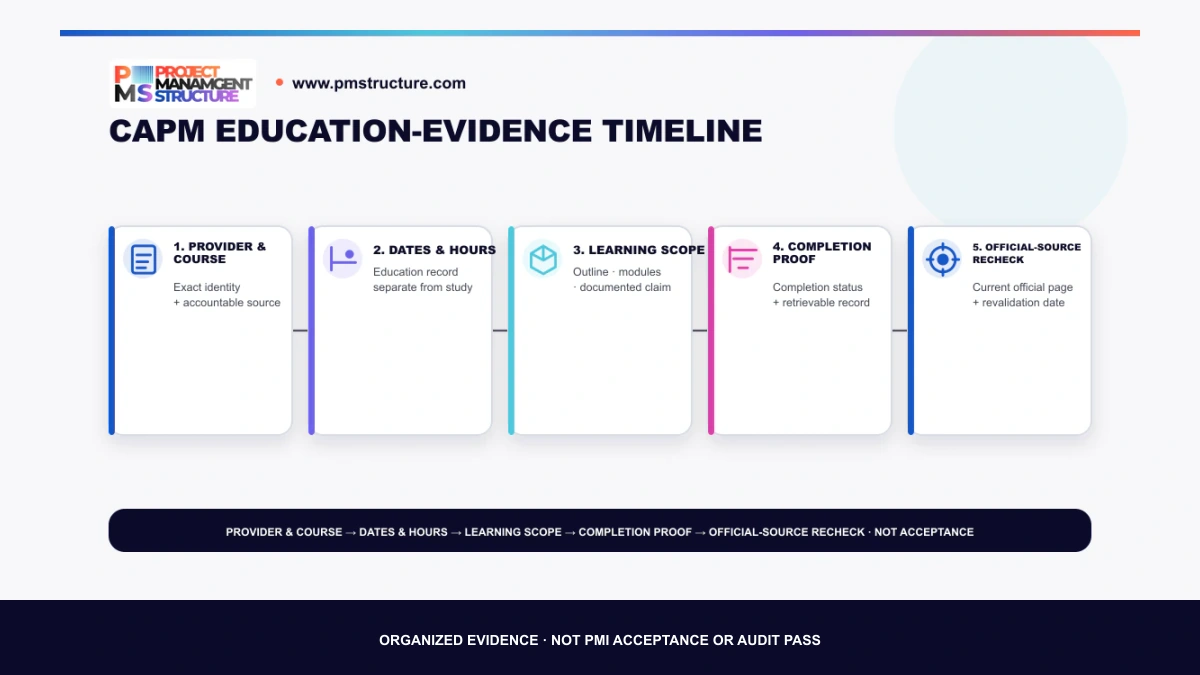 Desktop
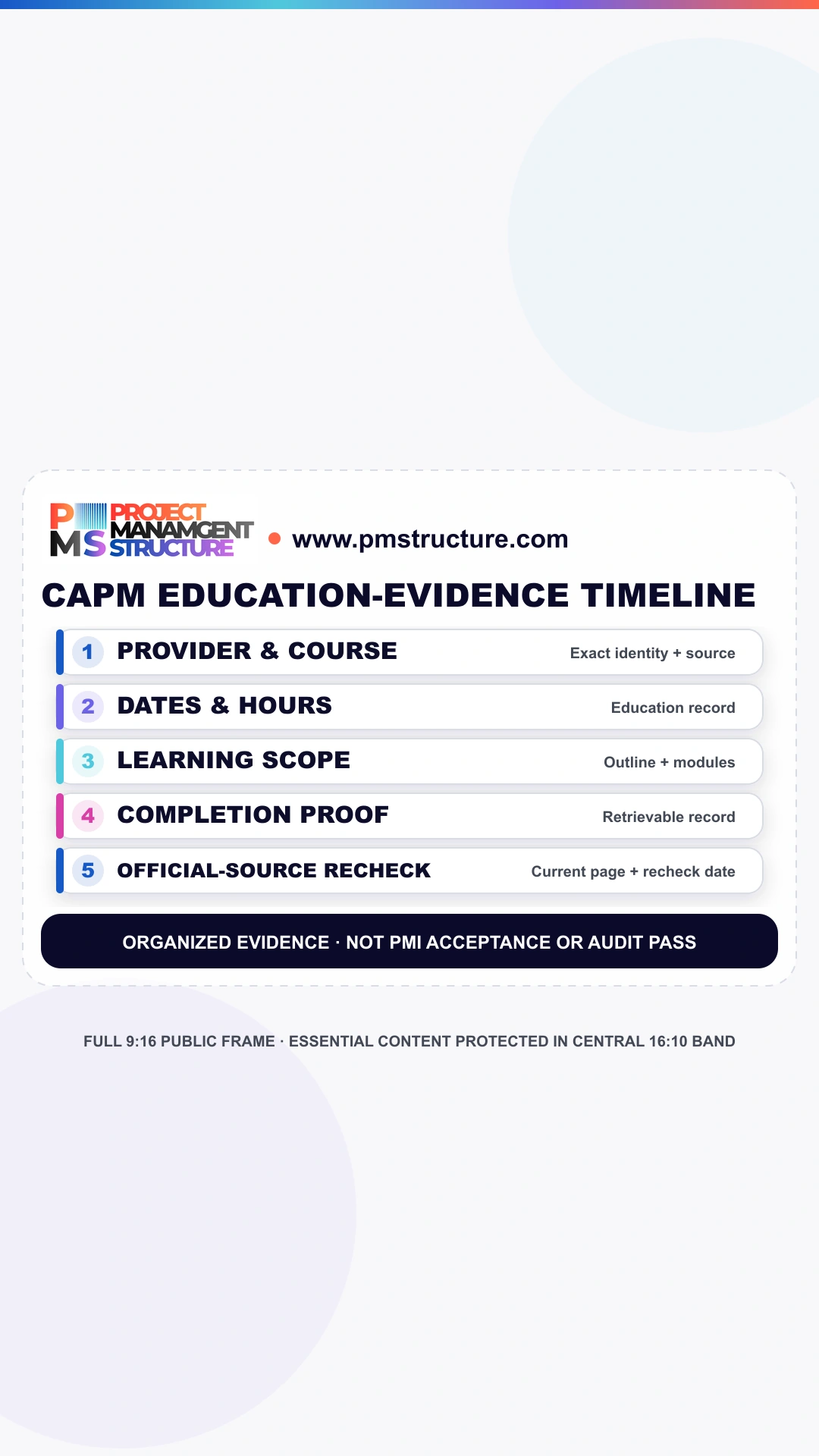 Mobile
1. Identify the learning claim
Record the exact course title and what the provider says the course covers.
Avoid writing only “CAPM training.” That label does not show the learning scope, delivery period, completion state or hours being claimed.
Capture:
- provider name;
- exact course title;
- course or enrollment reference;
- delivery mode;
- documented learning scope;
- hours the provider identifies as project-management education.
Do not add unrelated study time to reach a number. The evidence should show what the course documents.
2. Record the accountable source
Save the source that supports the course claim.
This may include an official course page, enrollment record, syllabus, provider statement or other controlled record. Record the source date because pages and course descriptions can change.
A marketing headline is not enough by itself. Compare the detailed course information and completion record with the current official CAPM condition. If the information is unclear, resolve the question before relying on it.
This is not a provider approval or rejection decision. It is evidence hygiene.
3. Separate dates and hours
Create distinct fields for:
- course start date;
- course completion date;
- certificate or completion-record date;
- documented project-management education hours;
- separate general study hours, if you track them.
Do not blend the education record and the study log.
Dates should also agree across the enrollment record, completion evidence and application information. An inconsistency does not automatically make a record invalid, but it is a gap to investigate before submission.
4. Capture completion evidence
Store the completion certificate or equivalent record in a location you can retrieve.
Record:
- the exact name shown on the document;
- provider and course title;
- completion date;
- hours, if the document states them;
- file name or reference;
- storage location;
- any mismatch that still needs resolution.
Do not assume attendance and completion are always the same. Describe the status the record actually supports.
5. Revalidate before application
Re-open the current official CAPM page and PMI’s certification resources before relying on the evidence.
Record:
- the URL checked;
- the date checked;
- the exact current wording that matters;
- any change from the earlier record;
- the action taken to resolve the change.
Provider requirements and application instructions can change. A source check performed at enrollment should not be treated as permanent.
Build one evidence register
Use a single register to make the claim inspectable.
| Field | What to record | Boundary |
|---|---|---|
| Provider and course | Legal or brand name and exact course title | No endorsement |
| Delivery dates | Start, completion and certificate dates | No invented timing rule |
| Education hours | Hours documented as project-management education | Do not relabel unrelated study |
| Learning scope | Course outline or module list | Not a PMI equivalency decision |
| Completion status | Complete, incomplete or unresolved—with date | Attendance is not automatically completion |
| Proof location | Certificate, file, URL or reference | Organization, not acceptance |
| Study log | Reading, practice and revision kept separately | Not automatically qualifying education |
| Source check | Official CAPM page and revalidation date | Current guidance still controls |
| Gap | Missing, inconsistent or unverifiable detail | Resolve before relying on it |
| Application checkpoint | Date evidence was reviewed before application | Not an eligibility decision |
The register is useful because it makes uncertainty visible. An empty proof-location field is different from a completed record. A provider’s claimed hours are different from hours a learner estimates. A study activity is different from documented project-management education.
Follow an evidence timeline
Use this sequence:
identify → enroll → learn → complete → capture → revalidate → apply
Identify
Read the current official CAPM condition and the detailed course information. Record the basis for expecting the course to support the education condition.
Enroll
Preserve the exact course identity, provider, delivery details and enrollment record.
Learn
Track course participation as required by the provider. Keep personal study outside the course in a separate log.
Complete
Finish the course requirements and confirm what the provider records as completion.
Capture
Save the completion record, documented hours and relevant learning-scope information.
Revalidate
Re-open the official CAPM requirement and compare it with the evidence. Resolve differences in names, dates, hours or scope.
Apply
Enter information accurately using the current application instructions. Do not infer acceptance from an organized file.
This order creates a completion checkpoint before the application/exam checkpoint without inventing a fixed number of days or a submission deadline.
Run five gap checks
Missing or unclear hours
If the course record does not show the hours you intend to claim, do not estimate or reconstruct them from memory. Ask the provider for authoritative clarification or choose not to rely on the record.
Inconsistent dates
Compare enrollment, delivery, completion and certificate dates. Record the reason for any difference and preserve the supporting explanation.
Missing completion proof
Locate the certificate or equivalent completion record before relying on the course. A payment receipt or enrollment confirmation may not establish completion.
Unclear learning scope
If the course title is broad or promotional, preserve the detailed outline. Do not assume a label proves alignment.
Stale official-source check
Re-open PMI’s current pages near application and publication. If the wording changed materially, stop and update the plan rather than forcing an old interpretation.
Keep evidence preparation separate from an audit decision
Organized evidence helps you state the claim accurately and retrieve the supporting record. It cannot predict PMI’s decision.
Do not invent:
- a mandatory PMI file name;
- a universal retention period;
- a response deadline;
- a required document format;
- an approval rule for every provider;
- a guarantee that one record is sufficient.
If PMI requests information, follow the current instructions PMI provides for that application. This article does not replace the certification handbook, application process or an official decision.
Avoid common mistakes
Treating 23 hours as total study time
Fix: keep the qualifying education record and broader study plan separate.
Counting work activity as education
Fix: record work as context, not as education, unless authoritative current guidance supports the exact claim.
Relying on a course name alone
Fix: preserve provider, learning scope, documented hours, completion status and proof.
Assuming attendance equals completion
Fix: use the status shown by the provider’s record.
Creating an audit checklist from guesses
Fix: organize the record, then follow current PMI instructions if an audit or evidence request occurs.
Using an old draft as current authority
Fix: work from the accepted title, current official sources and the newly approved manuscript. Historical drafts remain preserved evidence, not inherited truth.
Questions learners often ask
Does CAPM require prior project experience?
PMI’s current CAPM page says no prior project experience is required. The current education and secondary-degree conditions still apply.
Are 23 hours enough to pass CAPM?
The 23 hours are an education condition, not a universal pass-preparation estimate. Study needs differ, and this article makes no pass guarantee.
Does any reading or video time count?
Do not assume so. Rely on current official guidance and the documented course record rather than converting unrelated activity into qualifying education.
Is an Authorized Training Partner the only route?
PMI’s exam-preparation page presents Authorized Training Partner training as a route that fulfills the hours. The article does not claim it is the only possible route or endorse a provider. Check the current official requirement and course evidence.
What if my certificate and course page show different hours?
Treat that as an evidence gap. Preserve both records, seek authoritative clarification and do not rely on an unsupported number.
Does an audit-ready file guarantee acceptance?
No. It means the record is organized, consistent, retrievable and revalidated. Only PMI decides whether evidence is sufficient.
Organize the evidence before you rely on it
Open the current CAPM page. Record the course, provider, dates, documented hours, learning scope, completion status and proof location. Keep the broader study log separate. Resolve gaps before entering the information in an application.
The goal is not to make the file look certain. The goal is to make each claim accurate, traceable and current.
PM Structure is an independent education provider. CAPM is a mark of Project Management Institute, Inc. This article does not imply PMI endorsement and does not guarantee education equivalency, eligibility, application or audit acceptance, examination, employment or career outcomes.

Founder & Project Management Mentor
Sheikh M. AbdullahSheikh M. Abdullah leads PM Structure with practical guidance on project management certification, exam strategy, and delivery leadership.
View all articles by Sheikh M. AbdullahThis article is editorial content from PM Structure. It does not replace official certification-body guidance. For pathway and readiness support, explore certifications.
Related Articles

Workplace Safety Basics Every Team Should Know
PMP Renewal in 2026: Build an Audit-Ready 60-PDU Evidence System
Infrastructure Relationship Governance: Five Questions to Answer Before Delivery Starts
PMP or PMI-ACP in 2026? Choose by Work Evidence, Exam Scope and Career Direction
Stay ahead of the curve
Get weekly insights on certification strategy, agile leadership, and career growth.
View all articles