


Infrastructure Relationship Governance: Five Questions to Answer Before Delivery Starts
Five pre-delivery questions and a relationship-governance canvas for aligning outcomes, contracts, leadership, risk and capability across infrastructure partners.
Infrastructure projects are usually governed through scope, schedule, cost, risk, quality, safety and contract controls. Those controls are necessary. They are also incomplete when delivery depends on several organizations whose incentives, information and decisions must work together.
A contract can assign an interface without making the interface usable. A responsibility matrix can name owners while both parties wait for the other to act. A formal escalation route can exist while people avoid raising issues because every concern becomes a commercial position. Leaders can describe the project as a partnership while measures reward local optimization.
The result is a relationship problem that appears later as delay, claim, rework or unowned risk.
PMI’s July 2026 report, Designed to Deliver, argues that inter-organizational relationships should be treated as a core infrastructure delivery discipline. Developed with MIGSO-PCUBED and University College London, the report draws on 60 qualitative interviews with senior leaders across major infrastructure projects in five countries. It presents five recommendations: design relationships with purpose, design contracts that support collaboration, use leadership as a delivery lever, treat relationships as project risk, and invest in relational capability.
The practical implication is simple:
Do not wait for relationship quality to emerge from goodwill. Design the conditions, evidence and decision routes before delivery pressure exposes the gaps.
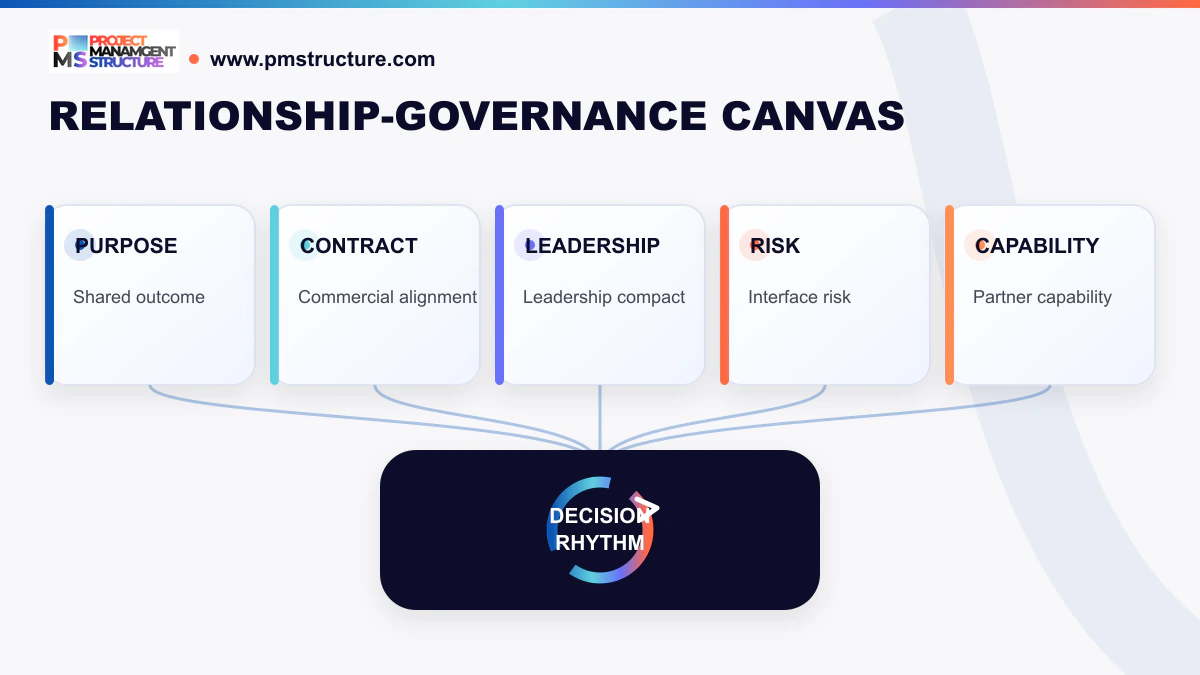
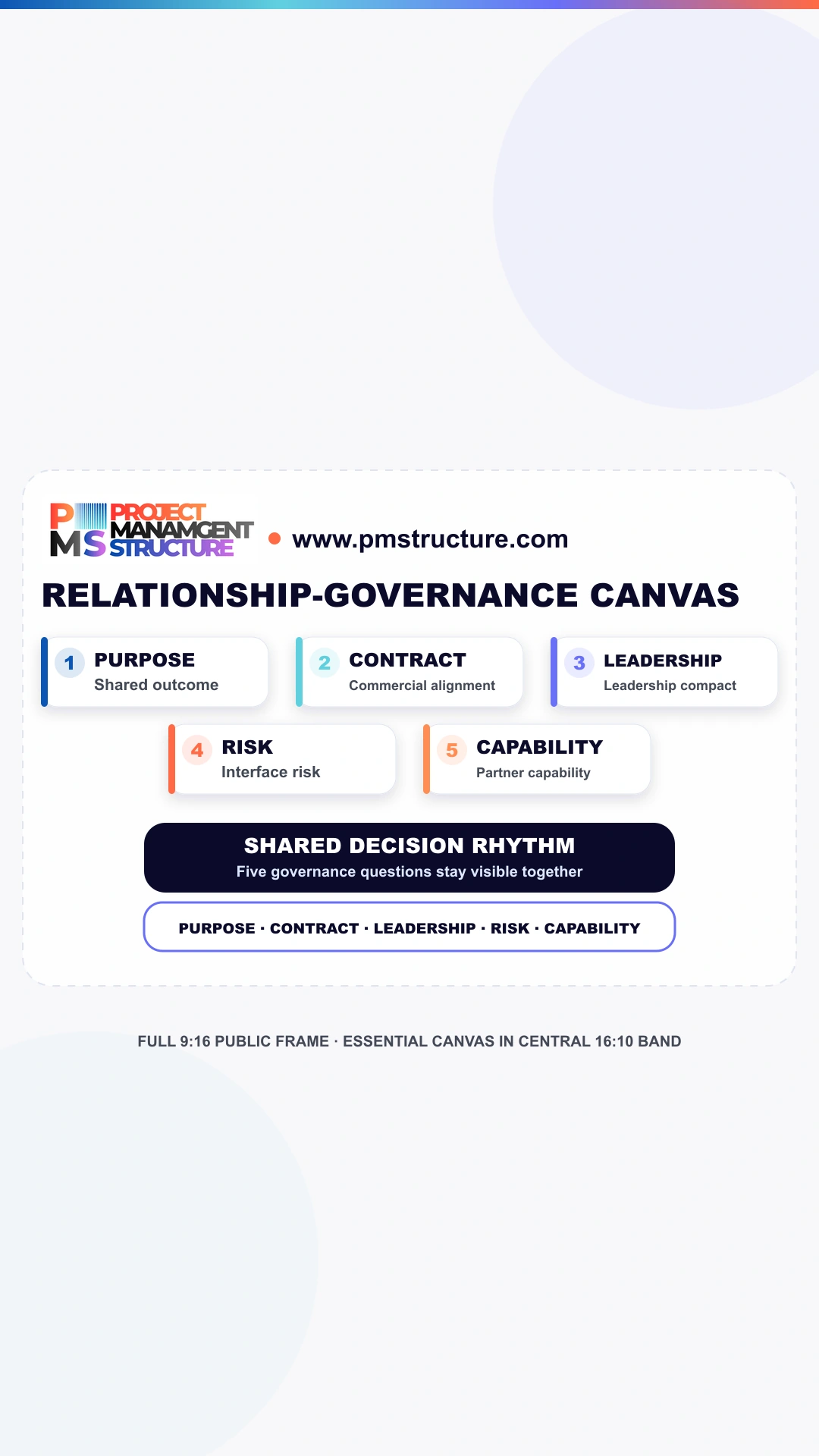
The following five questions convert that principle into a pre-delivery governance canvas.
Relationship governance is not “soft”
Relationship governance is the system through which organizations:
- align around the outcome they must deliver together;
- make and record cross-boundary decisions;
- exchange information needed for those decisions;
- manage incentives, disagreement and change;
- surface interface risk early;
- hold leaders and teams accountable for collaborative behaviour;
- repair working relationships when pressure changes them.
It does not replace the contract. It makes the contract operable across the human and organizational interfaces that the contract cannot manage by itself.
It is also not a request for constant agreement. Effective governance makes disagreement visible early enough to resolve it through evidence, authority and a defined route. A project with no recorded relationship tension may be aligned—or may have trained people to keep difficult information offline.
The five pre-delivery questions
 Desktop
 Mobile
| Question | Governance purpose | Minimum output |
|---|---|---|
| 1. What must this relationship deliver? | Align partners on shared outcomes and non-negotiable obligations | Relationship purpose statement and shared outcome measures |
| 2. Do commercial mechanisms support that purpose? | Test whether incentives, information duties and change routes encourage the required behaviour | Incentive-and-interface review with contradictions assigned |
| 3. What leadership behaviour will hold under pressure? | Make sponsor and partner conduct observable, not aspirational | Leadership compact and named escalation sponsors |
| 4. How will relationship and interface risk be controlled? | Treat breakdown, delay and concealment as risks with triggers and owners | Relationship-risk register and protected issue route |
| 5. Do the organizations have the capability to collaborate? | Check skills, capacity, systems and prior operating evidence | Capability plan, onboarding actions and support needs |
Answer the questions with the organizations that will perform the work. A client-only assessment of supplier readiness, or a contractor-only assessment of client behaviour, will reproduce the boundary the canvas is meant to govern.
Question 1: what must this relationship deliver?
Start with the shared delivery need, not a statement that the parties will “work collaboratively.”
Complete this sentence:
This relationship exists so that ______ can achieve ______ while protecting ______.
The first blank names the asset, service, program or public outcome. The second defines the value that requires joint action. The third captures non-negotiable obligations such as safety, regulatory compliance, operational continuity, environmental commitments or public accessibility.
Then identify the decisions that no single organization can make well alone:
- design acceptance across disciplines;
- access, possession or workfront release;
- system or asset interface changes;
- schedule recovery affecting several packages;
- testing and commissioning sequence;
- operational readiness;
- change with downstream commercial or regulatory effect.
For each decision, record the evidence, participants, authority and deadline. This turns “shared outcome” into a working governance obligation.
Do not use a shared measure that hides unequal exposure. An overall milestone can appear healthy while one partner carries an unmanageable approval queue or a critical interface has no accepted definition. Pair project-level outcomes with a small set of interface measures.
Question 2: do commercial mechanisms support the purpose?
PMI’s report explicitly recommends designing contracts that support collaboration and focusing the commercial model on key project outcomes.
This does not mean rewriting signed contracts in a workshop. It means testing whether the commercial and delivery mechanisms point in the same direction.
Review:
- incentives and pain/gain mechanisms;
- notice and information requirements;
- approval response times;
- change initiation and assessment routes;
- access to data and common systems;
- treatment of early warnings;
- ownership of contingency;
- dispute escalation;
- acceptance and payment dependencies.
Look for contradictions such as:
- the project asks for early risk disclosure but penalizes any disclosure as evidence of poor performance;
- partners are measured on local cost while the project requires cross-package optimization;
- a team is accountable for a milestone but cannot obtain the required input or decision;
- the schedule assumes concurrent work while approval rights remain sequential;
- lessons are requested but commercially sensitive information has no protected route.
Record each contradiction as a governance issue. Assign the smallest lawful correction: clarify an interpretation, align a measure, add a working protocol, obtain a formal variation through the authorized process, or escalate for qualified commercial and legal advice.
Relationship governance must never be used to bypass contractual authority. Its purpose is to expose where delivery expectations and formal mechanisms do not support one another.
Question 3: what leadership behaviour will hold under pressure?
Leadership narratives matter because teams watch what leaders reward when schedule, cost or reputation is threatened.
Create a short leadership compact for the sponsor and senior representatives of major partners. It should cover:
- the shared outcome they will protect;
- how they will respond to an early warning;
- which disputes they expect teams to resolve locally;
- which issues must reach them;
- how quickly they will make or sponsor a decision;
- how they will separate problem disclosure from blame;
- how they will communicate a changed decision across organizations.
Make the compact observable.
“We value transparency” becomes:
A material interface risk raised with evidence receives an owner and response date within the agreed governance window. The person raising it is not treated as the cause merely for surfacing it.
“We collaborate” becomes:
A cross-package recovery decision records the effect on total project value, safety, quality, operations and each affected party before approval.
If senior leaders routinely resolve issues in private and teams receive only the conclusion, the project loses the reasoning it needs for consistent decisions. Retain a proportionate decision record while protecting legally privileged, confidential or commercially restricted material.
Question 4: how will relationship and interface risk be controlled?
Relationship breakdown should appear in the risk system before it becomes a dispute.
Useful risk statements identify cause, event and effect:
Because the client design team and systems contractor use different interface baselines, an unapproved assumption may enter detailed design, causing rework and delayed testing.
Because early warnings are discussed only in commercial meetings, a delivery team may delay reporting an emerging access constraint, reducing the time available for mitigation.
Because two partner leads have conflicting approval expectations, a material change may circulate without a clear final decision, creating parallel instructions.
For each risk, define:
- early signal;
- owner;
- affected interfaces;
- preventive control;
- response trigger;
- escalation route;
- evidence to retain;
- review date.
Add a protected issue route for concerns that people will not raise through routine meetings. It may be a named sponsor pair, independent facilitator, safety route, ethics channel or qualified contractual process, depending on the issue. Do not combine matters that require different confidentiality and authority.
Track relationship risk through behaviour and decision evidence, not sentiment alone. Possible signals include repeated late decisions, unresolved interface actions, contradictory instructions, meetings held without required parties, early warnings that receive no owner, or issues repeatedly reopened because the rationale was not recorded.
These signals are not performance verdicts. They are prompts to inspect the operating relationship.
Question 5: do the organizations have the capability to collaborate?
Selecting a technically capable partner does not prove that the combined system can collaborate.
Assess capability at three levels:
- Individual: negotiation, listening, conflict handling, commercial awareness, systems thinking, and clear decision writing.
- Team: interface ownership, integrated planning, shared problem solving, evidence management, and learning reviews.
- Organization: compatible systems, available decision-makers, resource capacity, escalation support, incentives, and experience in the chosen delivery model.
Ask for evidence relevant to the work:
- Who has led comparable interfaces?
- Which decision-makers are actually available?
- Can the organizations exchange the required data securely and in time?
- Are commercial and technical teams using the same assumptions?
- How will new people be onboarded after mobilization?
- Which capability must be developed rather than assumed?
If a gap exists, choose a control proportionate to the exposure: paired leadership, interface coaching, joint planning, simulation of a critical decision, common data definitions, facilitated risk review, or a staged release of responsibility.
Training is useful only when it changes an operating need. “Collaboration workshop completed” is an activity. “Interface owners can now run the agreed decision protocol and produce an accepted record” is evidence.
Build the relationship-governance canvas
Use one page per material cross-organizational relationship.
| Canvas field | Working prompt |
|---|---|
| Relationship scope | Which organizations, packages, assets and phases are included? |
| Shared outcome | What requires joint success rather than local completion? |
| Protected obligations | Which safety, legal, regulatory, operational or public commitments cannot be traded away? |
| Critical decisions | Which decisions require evidence or authority from more than one party? |
| Commercial alignment | Which incentives, notices, approvals or payment dependencies support or obstruct the outcome? |
| Leadership compact | What will senior leaders do when risk, change or conflict appears? |
| Interface risks | Which relationship failures can affect delivery, and what are the early signals? |
| Capability | Which skills, capacity, systems and experience exist or are missing? |
| Governance rhythm | Which routine and trigger-based forums make decisions and close actions? |
| Evidence | Where are decisions, assumptions, actions and acceptance retained? |
The canvas should point to controlled project records. It should not become a parallel contract, risk register or decision log.
Establish an operating rhythm
Use a small number of forums with distinct purposes.
Mobilization alignment
Before delivery starts, confirm the canvas, interfaces, decision rights, protected obligations and immediate capability gaps. Test one realistic cross-boundary decision.
Weekly interface control
Review near-term dependencies, decisions due, assumptions, access, information exchange and early warnings. Close or escalate actions with an owner and date.
Monthly relationship-governance review
Inspect patterns rather than individual tasks:
- repeated decision latency;
- incentives producing local optimization;
- unresolved leadership commitments;
- relationship risks trending toward issues;
- capability or capacity gaps;
- lessons requiring a governance change.
Trigger-based escalation
Do not wait for the next meeting when a defined trigger occurs. Examples include safety exposure, regulatory risk, contradictory formal instruction, unowned material change, threatened operational readiness, or failure to respond within an agreed decision window.
The escalation route must identify who can decide—not only who receives the message.
A hypothetical interface example
Imagine an infrastructure program with a civil contractor, systems integrator, operating organization and client design authority.
The integrated schedule assumes that equipment-room access will be available before systems installation. The civil contractor measures completion by area handover. The operator requires additional maintainability evidence. The design authority believes the evidence can follow during testing. The systems integrator cannot mobilize without an accepted access and design baseline.
On a schedule, this appears as one late handover.
On the relationship canvas, it reveals:
- no shared definition of “ready for access”;
- measures that reward different completion points;
- an interface decision with no single owner;
- a protected operational obligation entering too late;
- a supplier likely to absorb standby cost while waiting.
The corrective action is not “communicate better.” The partners must define the acceptance evidence, assign the decision, align the milestone logic, record the commercial effect through the authorized route, and review similar interfaces before they repeat.
This example is fictional. It illustrates how relationship governance converts a future dispute into a decision that can still be designed.
Common mistakes
Mistake 1: treating goodwill as a control
Strong personal relationships help, but projects need routes that survive leadership changes and commercial pressure.
Mistake 2: creating a charter that contradicts the contract
Use the canvas to align operations and expose contradictions. Formal changes must follow authorized contractual and legal processes.
Mistake 3: making collaboration one party’s duty
If only suppliers are assessed for relationship capability, the client side of the interface remains invisible.
Mistake 4: escalating every disagreement
Leadership involvement is valuable when the issue exceeds local authority or crosses a defined trigger. Constant escalation prevents capability from developing where the work happens.
Mistake 5: recording only positive relationship measures
Attendance, workshops and survey scores do not show whether early warnings receive decisions or interfaces close. Include operating evidence.
Mistake 6: waiting for a dispute to create the route
Design the protected issue and escalation paths while relationships are stable.
Frequently asked questions
Is relationship governance only for alliances or collaborative contracts?
No. The mechanisms must fit the contract and delivery model, but any infrastructure project with material organizational interfaces benefits from explicit outcomes, decisions, risks and escalation routes.
Does this replace stakeholder management?
No. Stakeholder management covers a wider set of people and interests. Relationship governance focuses on the organizations that must make and execute interdependent delivery decisions.
Should relationship risks be kept separate from the main risk register?
Use the project’s controlled risk system where possible. A focused relationship-risk review can feed that system, but it should not hide material risks in a private document.
Who owns the canvas?
The accountable project or program leader should ensure it exists. Specific decisions and risks must have owners from the organizations with the relevant authority. A PMO or interface manager can facilitate without becoming the owner of every relationship.
How often should it be refreshed?
At mobilization, major phase transitions, partner or leadership changes, material contract changes, and when repeated interface signals show that the current design no longer works.
Next action
Select the one relationship that carries the greatest delivery exposure. Bring the relevant organizations together and answer the five questions with evidence. If the group cannot agree on the shared outcome, critical decisions, commercial support, leadership behaviour, risk route and capability, do not disguise the gap as “stakeholder engagement.” Assign it as governance work.
If your program needs a structured review of partner interfaces, decision rights and escalation evidence, request a PM Structure governance review. The review should clarify the operating relationship and next control—not promise that collaboration alone will deliver the project.
References
- Project Management Institute. Designed to Deliver: How Relationship Management Drives Infrastructure Project Success. July 2026.

PM Structure Editorial Role
PMO & Transformation MentorA PM Structure editorial role covering PMO governance, transformation, portfolio delivery, and organisational capability.
View all articles by PMO & Transformation MentorThis article is editorial content from PM Structure. It does not replace official certification-body guidance. For pathway and readiness support, explore certifications.
Related Articles
PMP or PMI-ACP in 2026? Choose by Work Evidence, Exam Scope and Career Direction
CAPM 23 Hours: Build an Audit-Ready Education Evidence Plan
PMI-RMP Eligibility: Separate Project Risk Experience From General Project Work
Close the Change-Readiness Gap: A Four-Condition Execution Check for Transformation Leaders
Stay ahead of the curve
Get weekly insights on certification strategy, agile leadership, and career growth.
View all articles