


PMP or PMI-ACP in 2026? Choose by Work Evidence, Exam Scope and Career Direction
Compare current PMP and PMI-ACP evidence, training and exam scope before choosing a credential pathway.
The first question is not, “Which credential sounds stronger?”
It is, “Which pathway can I support with evidence, and which published scope matches the capability I need to develop?”
That change in starting point matters. PMP and PMI-ACP are not interchangeable labels. Their current eligibility routes, training conditions and exam scopes ask different questions. Choosing by popularity, perceived seniority or a job title can hide an evidence gap that only appears when the application is being prepared.
A responsible decision follows this sequence:
document the work → check the learning condition → compare the exam scope → examine the work context → state the intended direction
This is not a scoring model. It is a way to stop assumptions from deciding for you.
Begin with the work you can document
Write down responsibilities before credential names.
For each relevant period, record:
- the project, product, program or delivery context;
- the dates and whether any periods overlap;
- what you were personally responsible for;
- which decisions you made or supported;
- how you worked with teams and stakeholders;
- what evidence or verifier can support the account.
Do not rely on a title such as project manager, scrum master, product owner or delivery lead. A title may be useful context, but it does not show the work performed.
The key distinction for this decision is between project-leadership evidence across ways of working and agile-specific experience. Some work may contribute useful context to both. That does not make the two evidence tests identical, and it does not authorize the same period to be described carelessly.
Understand the current PMP boundary
PMI’s current PMP certification page describes project leadership without tying the credential to one method. It explicitly places predictive, hybrid and agile work inside the scope.
The page currently lists four education-and-experience routes:
| Education route | Current experience condition shown by PMI |
|---|---|
| High-school diploma or qualifying secondary equivalent | Five years managing projects |
| Associate degree or vocational trade-school diploma | Four years managing projects |
| Bachelor’s degree or higher | Three years managing projects |
| Bachelor’s or postgraduate degree from a PMI GAC-accredited program | Two years managing projects |
PMI says the experience is counted within the last ten years and overlapping project periods must not be double-counted. The current page also lists 35 hours of project professional training. An active CAPM is one route PMI identifies for that training condition; it does not replace the separate experience requirement.
These are application boundaries, not a promise of acceptance. A candidate still needs to describe the actual projects and responsibilities truthfully and follow the current official instructions.
The PMP exam also changed in July 2026. PMI’s current exam-transition page says the updated exam launched in July and now uses People 33%, Process 41% and Business Environment 26%. The official 2026 outline indicates approximately 40% predictive and 60% adaptive, agile and hybrid approaches across the examination.
Those percentages describe exam coverage. They do not prescribe how to divide study time, and they do not make PMP an agile-only credential.
The July 2026 timing creates an additional record-control need. A saved study note, course outline or comparison written for the prior PMP examination can still be useful background, but it should not be treated as the current scope without review. Mark the version and date of every outline used in the decision file. If two records show different domain weights or experience windows, do not blend them into an average. Identify which official source is current, preserve the older record as history and update the decision from the current source. This is source control, not a claim that every older learning resource is unusable.
Understand the current PMI-ACP boundary
PMI’s current PMI-ACP certification page starts with secondary education or higher and requires one of several agile-experience routes.
The current routes include:
- two years of agile experience within the past five years;
- a degree from a PMI GAC-accredited program plus one year of agile experience;
- a qualifying third-party agile certification plus one year of agile experience;
- a PMP certification route.
The official PMI-ACP examination outline identifies an active PMP for that route. Because status and provider wording can change, re-open the current page and outline when preparing an application.
That experience route is only one part of the check. PMI separately lists 21 hours of formal training in agile practices, frameworks and methodologies.
This distinction prevents a common error:
A PMP route for the agile-experience condition is not the same as satisfying the formal agile-training condition.
The current PMI-ACP exam is 120 questions in 180 minutes. Its March 2026 outline uses four domains:
- Mindset — 28%;
- Leadership — 25%;
- Product — 19%;
- Delivery — 28%.
These domains provide a scope map. They do not create a readiness score, a difficulty ranking or a universal preparation schedule.
Compare scope without ranking value
PMP and PMI-ACP can both include agile contexts, but they frame capability differently.
PMP covers the leadership of projects across predictive, adaptive, agile and hybrid ways of working, with People, Process and Business Environment as the published domains.
PMI-ACP concentrates on agile practice across Mindset, Leadership, Product and Delivery. Its experience routes and formal agile training make that focus visible before the exam is considered.
“Broader” is not the same as “better.” “Agile-specific” is not the same as “more advanced.” The useful question is whether the published scope matches the responsibility you need to strengthen and the evidence you can support now.
Use a five-field decision matrix
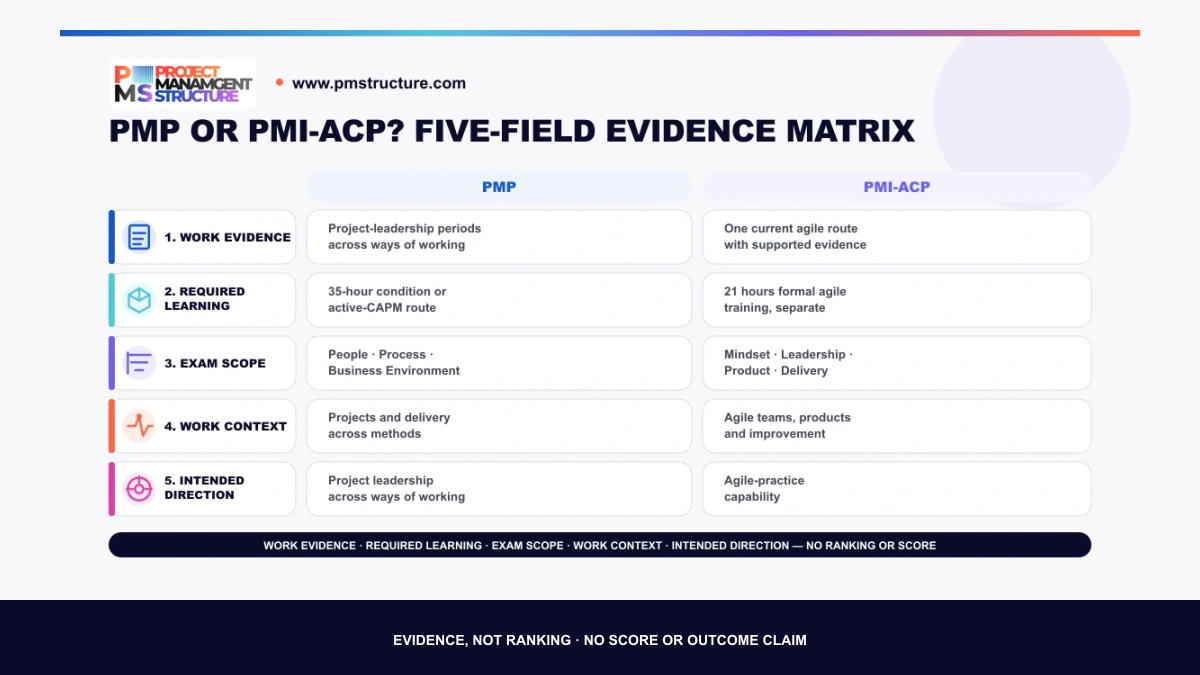 Desktop
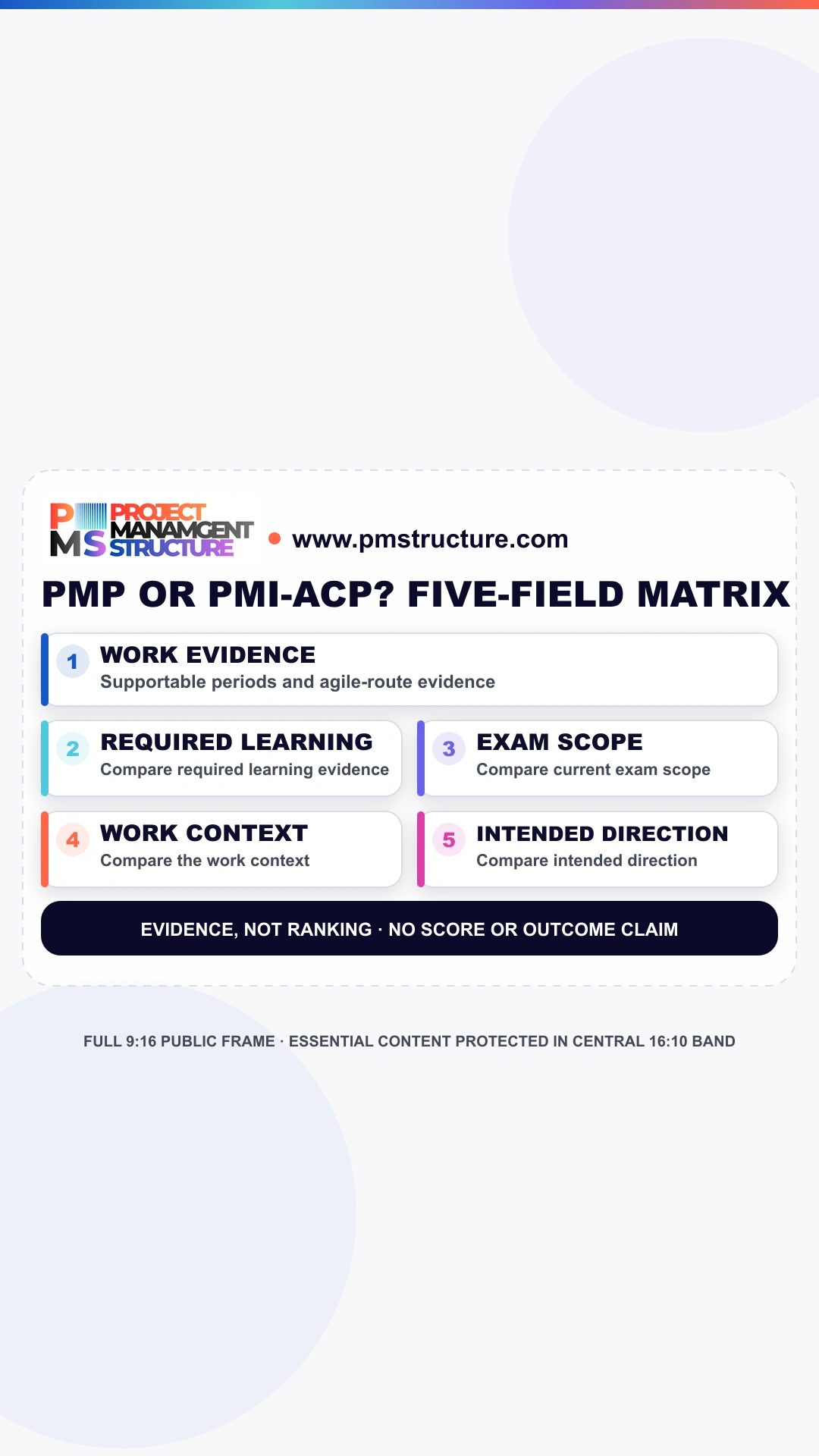 Mobile
The matrix below is PM Structure synthesis. It is not a PMI eligibility assessment, score or endorsement.
| Decision field | PMP evidence prompt | PMI-ACP evidence prompt |
|---|---|---|
| Work evidence | Which non-overlapping periods show responsibility for managing projects? | Which current route can you evidence, including agile work where the route requires it? |
| Required learning | Can you document the current project-professional training condition or the active-CAPM route identified by PMI? | Can you document 21 hours of formal agile training separately from the experience route? |
| Exam scope | Do People, Process and Business Environment across ways of working match the capability you need? | Do Mindset, Leadership, Product and Delivery match the capability you need? |
| Work context | Are you accountable for projects, decisions, delivery and outcomes across methods? | Are agile teams, products, delivery and improvement central to your responsibility? |
| Intended direction | Do you need to deepen project-leadership capability across ways of working? | Do you need to deepen agile-practice capability? |
Complete the matrix with evidence statements, not impressions.
“I have worked in agile” is an impression. “From March 2024 to June 2026, I facilitated planning and review with an agile product team, supported backlog decisions and helped remove delivery impediments; the product owner can verify the period” is an evidence statement.
“I lead projects” is also too broad. Record the project objective, dates, your planning and decision responsibility, delivery accountability and the people who can verify the work.
Keep education and experience separate
Applications become confusing when three records are blended:
- work experience;
- qualifying education or formal training;
- broader study and exam preparation.
Maintain separate logs.
Your work-evidence log should contain dates, context, personal responsibilities, outcomes addressed, overlaps and verifier information.
Your training log should contain provider, course title, delivery dates, stated qualifying hours, completion status and proof location.
Your study log can contain reading, practice questions, reflection and revision. It supports preparation, but it should not be relabelled as qualifying training without official support.
Keeping the logs separate makes missing evidence visible without forcing a conclusion.
Recognize three responsible outcomes
PMP currently fits
This outcome is reasonable when one current PMP education-and-experience route is supportable, the training condition is documented and the published project-leadership scope matches the capability direction.
It does not mean PMI will accept the application or that the credential will produce a job or salary outcome.
PMI-ACP currently fits
This outcome is reasonable when the education condition, one current agile-experience route and the separate 21-hour formal agile-training condition are supportable, and the four-domain scope matches the intended capability.
If the route relies on PMP status, verify that status and still check the training condition separately.
Neither pathway is ready enough to force
This is a valid result.
An unclear date record, an unsupported experience description or incomplete training evidence is a reason to resolve the gap—not a reason to choose whichever application seems easier.
Record the gap, its owner, the evidence needed and the next review point. Do not convert a plan to gain experience into experience already completed.
Build one evidence file before deciding
Create a simple register with these fields:
| Field | What to capture |
|---|---|
| Evidence route | The exact current official route being checked |
| Education | Qualifying education and supporting record |
| Work period | Start/end dates and overlap treatment |
| Responsibility | What you personally led, managed or performed |
| Context | Project, product, team and way of working |
| Training | Course, provider, hours, completion and proof |
| Verifier | Person or record that can support the account |
| Source check | Official page/outline and revalidation date |
| Gap | Missing, inconsistent or unsupported information |
| Decision | PMP, PMI-ACP or hold—plus the evidence-based reason |
This is an organizational tool, not a PMI form. It cannot determine eligibility.
Review the register as a connected record. The experience route should match the education record and the selected credential. The training document should support the hours being claimed. Dates should be consistent across the register and the supporting files. A verifier should be able to confirm the responsibility described, not merely the existence of the project or team. Where a field remains uncertain, label it unresolved and identify the next evidence action rather than filling the space with a confident assumption.
Avoid the most common shortcuts
Choosing by perceived prestige
Fix: compare supported evidence and published scope, not reputation claims.
Treating all agile work as equivalent evidence
Fix: identify the current PMI-ACP route and document responsibilities and dates that support it.
Assuming PMP removes every PMI-ACP condition
Fix: check the experience route and the 21-hour formal agile-training condition separately.
Counting a title instead of work
Fix: describe responsibility, decisions, context, dates and verification.
Turning exam weights into study-time rules
Fix: use weights as coverage information, then build a study plan from actual knowledge gaps.
Applying because neither record is complete
Fix: hold, resolve the evidence gap and re-open the current official sources.
Questions practitioners often ask
Is PMP a prerequisite for PMI-ACP?
No. The current PMI-ACP page lists several alternative experience routes. PMP is one route, not a universal prerequisite.
Does PMP automatically make me eligible for PMI-ACP?
No. The current route still sits alongside education and a separate 21-hour formal agile-training condition. Only PMI decides whether an application satisfies the current requirements.
Is PMI-ACP only for someone with an agile job title?
The evidence should describe agile responsibilities and the selected official route. A title alone does not establish the work.
Is PMP only predictive?
No. PMI’s current PMP scope includes predictive, hybrid and agile ways of working.
Can exam-domain percentages tell me which credential is easier?
No. They describe coverage. They do not provide a difficulty comparison, pass rate or preparation guarantee.
What if my evidence fits neither route today?
Document the gap and address it responsibly. Do not force an application or claim experience that has not occurred.
Make the evidence decision first
Re-open the current official pages. Complete the five-field matrix. Verify each date, responsibility, training record and route before deciding.
Choose PMP when the supported project-leadership evidence and scope fit. Choose PMI-ACP when the supported agile route, formal training and scope fit. Choose neither yet when the evidence does not support a responsible application.
The credential name comes after the evidence—not before it.
Choose Your Certification Path
PM Structure is an independent education provider. PMP and PMI-ACP are marks of Project Management Institute, Inc. This article does not imply PMI endorsement and does not guarantee eligibility, application acceptance, examination, employment or career outcomes.

PM Structure Editorial Role
PMP Readiness MentorA PM Structure editorial role providing source-reviewed guidance on PMP readiness, exam preparation, and study planning.
View all articles by PMP Readiness MentorThis article is editorial content from PM Structure. It does not replace official certification-body guidance. For pathway and readiness support, explore certifications.
Related Articles

Workplace Safety Basics Every Team Should Know
PMI-RMP Eligibility: Separate Project Risk Experience From General Project Work
CAPM 23 Hours: Build an Audit-Ready Education Evidence Plan
Close the Change-Readiness Gap: A Four-Condition Execution Check for Transformation Leaders
Stay ahead of the curve
Get weekly insights on certification strategy, agile leadership, and career growth.
View all articles