


PMI-RMP Eligibility: Separate Project Risk Experience From General Project Work
A responsible PMI-RMP experience-evidence guide that separates professional project risk-management responsibilities from general project work before an eligibility review.
Working on a project that has risks is not the same as performing professional project risk-management work.
Almost every project contains uncertainty. Team members encounter assumptions, issues, suppliers, deadlines, technical constraints and stakeholder concerns. That exposure does not automatically make every month of participation eligible project risk-management experience.
The responsible question is more specific:
What project risk-management responsibility did I actually perform, in what professional setting, during which dates, and what evidence supports that description?
This article helps you answer that question before you rely on an experience claim. It explains the current eligibility sets, shows how to separate risk responsibility from general project work and provides a record structure for an ethical review.
It does not determine your eligibility. Only PMI can make that decision through its current application and, where applicable, audit process.
Start with one complete current eligibility set
The current PMI Risk Management Professional certification page presents three sets of education, project risk-management experience and risk-education requirements.
| Set | Education | Project risk-management experience | Risk-management education |
|---|---|---|---|
| A | High school or secondary school diploma, or global equivalent | 36 months/3 years within the last 5 years | 40 hours |
| B | Bachelor's degree or higher, or global equivalent | 24 months/2 years within the last 5 years | 30 hours |
| C | Bachelor's degree or higher from a PMI Global Accreditation Center-accredited program | 12 months/1 year within the last 5 years | 30 hours |
Treat each row as a complete set. Do not select the experience period from one row, the education condition from another and the training hours from a third.
Recheck the live page before an application decision. A saved course slide, screenshot or old outline can become stale. In the sources reviewed for this article, an older note in the official Examination Content Outline does not match the current public GAC set. The current certification page controls the eligibility wording used here.
Why general project participation is not enough
The current application guidance asks candidates to document experience related to past projects and training. It gives examples such as where they worked, their role and responsibilities, project duration, training, institutions and qualifying hours. It also directs applicants to describe their own role and responsibilities rather than the project itself.
That distinction prevents a common evidence problem.
Weak description:
The project had many risks, a risk register and weekly risk meetings. It delivered a new customer platform.
This describes the project. It does not show what the candidate did.
Stronger structure:
I facilitated risk-identification sessions for the integration workstream, documented causes, events, effects and owners, coordinated qualitative assessment using the agreed scales, and monitored assigned responses at weekly checkpoints from March to August.
This structure is more specific, but it still requires truthful support. The aim is not to make the wording sound impressive. It is to make the responsibility clear enough to compare with the current rules.
Use responsibilities, not titles, as the starting point
A job title may help provide context, but it is not a substitute for evidence.
Two people with the same title can perform different work. A project coordinator may own a defined risk process for one workstream. A manager may attend risk meetings but not perform risk-management responsibilities. A specialist may analyse a technical threat without owning the broader project risk process.
Do not upgrade a title in the record. Do not downgrade real responsibility because the title appears junior. Describe:
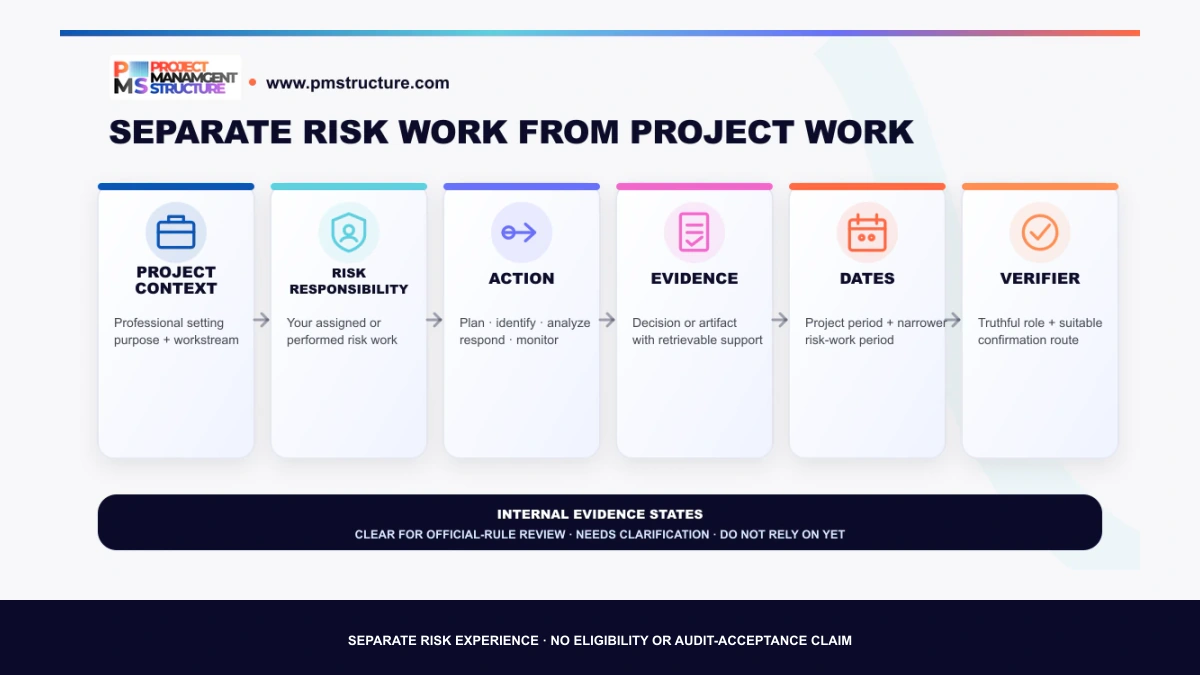
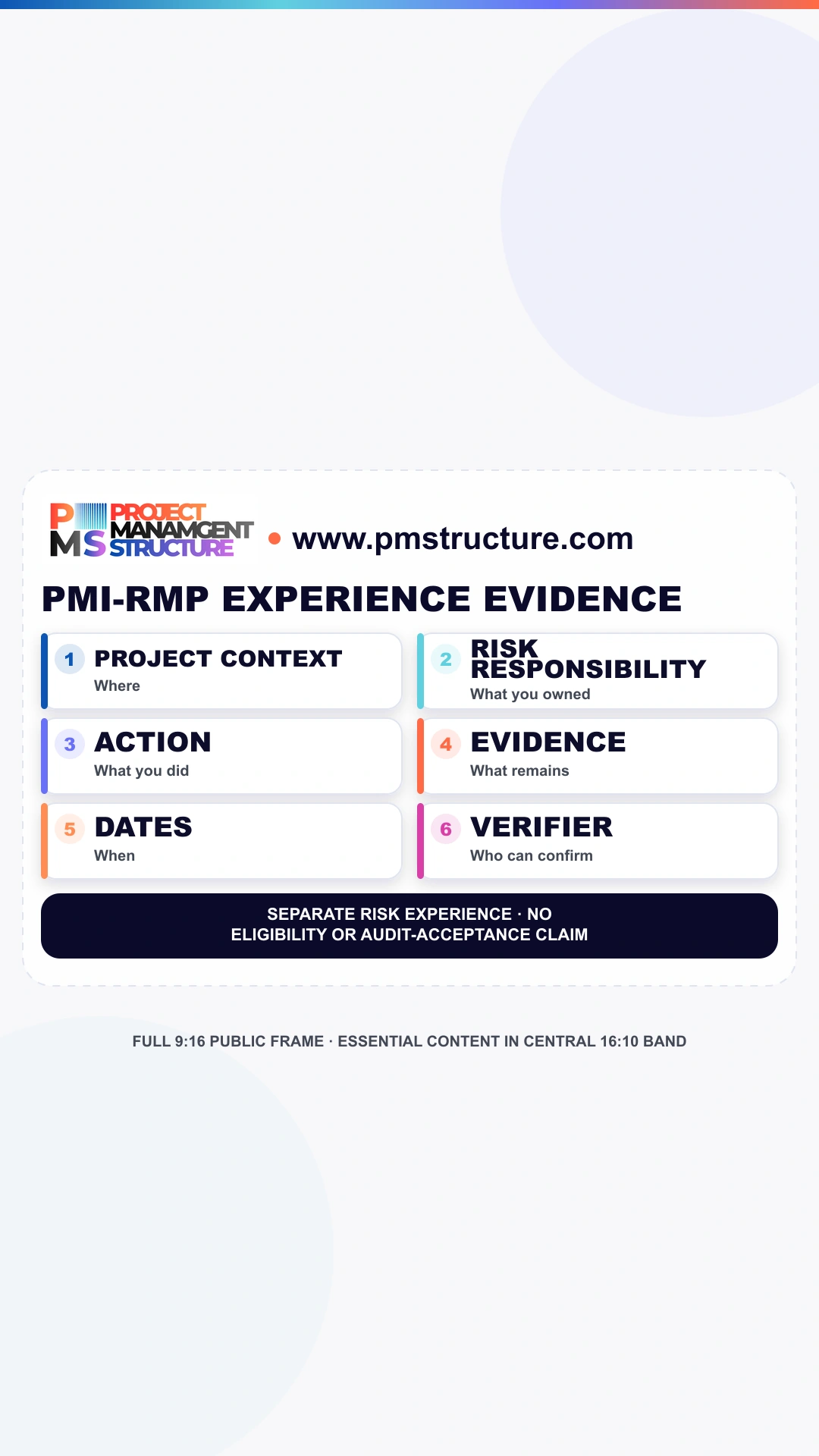
- the professional project context;
- the responsibility assigned to you;
- the action you performed;
- the decision, artifact or communication you produced;
- the dates during which the responsibility occurred;
- the supervisor, client or other possible verification route;
- the evidence that remains retrievable.
This produces a factual record. It does not produce an automatic eligibility verdict.
Know the professional-setting boundary
The official PMI-RMP Examination Content Outline states that the experience does not necessarily have to be paid, but it must occur in a professional setting. It gives school projects and planning personal events as examples that do not qualify, and it instructs candidates to record projects individually.
This boundary should be applied conservatively.
Do not assume that an unpaid responsibility is excluded simply because it was unpaid. Do not assume that an informal activity is included because it involved uncertainty. Record the setting, accountable organization or client, project purpose, governance and your actual professional responsibility.
If the setting is ambiguous, mark it for clarification rather than forcing it into the record.
Separate project dates from risk-work dates
A project can last longer than your risk responsibility.
You may join after initiation, leave before closure, perform risk analysis during a defined phase or support monitoring for only one workstream. Recording the full project duration can overstate the months in which you specialised in project risk management.
Use two date ranges:
| Date field | Purpose |
|---|---|
| Project period | Establishes the wider project context |
| Your risk-responsibility period | Shows when you actually performed the described work |
For each period, record the source of the dates: assignment record, project plan, meeting cadence, artifact history, supervisor confirmation or another legitimate record.
Do not reconstruct precise dates from confidence alone. Use an uncertainty note when the evidence needs confirmation.
Build the experience-separation matrix
 Desktop
 Mobile
Create one row per project or materially different responsibility.
| Field | What to record | Warning sign |
|---|---|---|
| Project context | Organization/client, project purpose and professional setting | Personal or academic activity presented without a qualifying professional setting |
| Risk responsibility | The risk-management responsibility actually assigned or performed | “Risks existed on the project” with no individual responsibility |
| Action | What you planned, identified, analysed, responded to, monitored or communicated | Passive attendance or unrelated project work |
| Decision/artifact | Risk plan, register entry, analysis, response, report, escalation, monitoring note or lesson | Artifact named but contribution unclear |
| Dates | Project period and narrower risk-responsibility period | Whole project duration used automatically |
| Evidence | Retrievable record supporting context, action and dates | Memory only or a document that proves the project but not the responsibility |
| Role/verifier | Truthful title, accountable supervisor/client and verification route | Inflated title or verifier who cannot support the claim |
| Eligibility set | One complete current set selected after evidence review | Conditions mixed across sets |
Use three internal evidence states:
- Clear for official-rule review: the responsibility, dates and support are specific enough to compare with the current official requirement.
- Needs clarification: the work likely occurred, but the boundary, evidence, dates or wording must be confirmed.
- Do not rely on yet: the claim depends on title, general participation, project-wide activity or unsupported memory.
These are PM Structure organization labels. “Clear” does not mean PMI has accepted the experience.
Distinguish risk work from nearby project tasks
General project work can be important without being project risk-management experience.
Status reporting
Reporting a missed milestone is not automatically risk monitoring. Risk monitoring normally involves an uncertain exposure, its trigger or condition, response effectiveness and a decision about what changes next.
Issue management
Resolving a current issue is not automatically managing the earlier risk. The work may connect if you monitored the trigger, activated a contingency, updated exposure and captured learning. Describe the actual connection rather than converting every issue action into risk work.
Planning
Building a schedule is general project planning. Assessing schedule uncertainty, defining risk thresholds, analysing exposure or planning a risk response may be risk-management work when those were your responsibilities.
Stakeholder communication
Attending a meeting is not enough. Facilitating risk identification, communicating exposure against thresholds, securing response ownership or escalating a changed risk level may be relevant when supported.
Technical analysis
A technical investigation can inform risk analysis. Record whether you identified uncertainty, estimated effect on project objectives, compared response choices or monitored changed exposure. Do not claim broader ownership than the evidence shows.
The aim is not to exclude valuable work. It is to describe each activity under the correct evidence category.
Use the five domains as prompts, not a quota
The current outline covers:
- Risk Strategy and Planning;
- Risk Identification;
- Risk Analysis;
- Risk Response;
- Monitor and Close Risks.
These domains can help you recall responsibilities, but the source pack does not support a claim that every applicant must demonstrate every domain in every project.
Use prompts:
- Did I assess context, appetite, thresholds, roles or communication?
- Did I facilitate or document risk identification?
- Did I perform or support qualitative or quantitative analysis?
- Did I plan, own, coordinate or evaluate responses?
- Did I monitor exposure, triggers, response effectiveness, emerging risks or closure?
Record only what you did. A blank domain is better than invented coverage.
Create a monthly evidence record
Do not wait until an application is imminent.
Once a month, or at another stable professional cadence, record:
- project and workstream;
- current risk responsibility;
- dates active;
- decisions supported;
- artifact created or updated;
- stakeholder or supervisor involved;
- outcome or change observed;
- evidence location;
- wording/evidence gap to resolve.
The record should preserve enough context to support a future truthful description without collecting confidential material that you are not allowed to retain.
Follow employer, client, contractual, security and privacy rules. Record references or sanitized descriptions where copying the underlying artifact is not permitted.
Run an ethical gap review
Before relying on a project entry, ask:
- Does the description explain my responsibility rather than only the project's importance?
- Can I separate general participation from risk work?
- Are the dates supported and limited to the responsibility period?
- Does the evidence show what I did?
- Is the possible verifier appropriate and aware of the actual work?
- Am I using one complete current eligibility set?
- Have I rechecked the current official page?
- Have I removed confidential or unsupported details?
If the answer is no, resolve the gap or mark the entry as not ready to rely on.
Do not ask a supervisor to confirm wording they cannot support. Do not create an artifact after the fact and present it as a contemporaneous record. Do not change a title to make the experience appear more senior.
A hypothetical comparison
Consider two hypothetical records from the same transformation project.
Record A: general project participation
Participated in weekly project meetings, updated the action log and supported status reporting for eight months.
This may be valuable project work. The record does not establish a project risk-management responsibility.
Record B: specific risk responsibility
For the data-migration workstream, facilitated fortnightly risk-identification reviews, maintained the causes/triggers/owners in the risk register, coordinated qualitative assessment against the approved scales, and reported response effectiveness to the workstream lead for six months.
Record B provides a clearer basis for official-rule review because it states context, responsibility, actions, artifact, cadence and duration.
It is still hypothetical. A real candidate must have truthful support, meet one current eligibility set and receive PMI's decision.
Understand the audit boundary
The current certification page gives examples of audit evidence, including a degree copy, supervisor-signed experience verification and certification or proof of experience.
Treat these as official examples, not a guarantee that a particular record will be accepted. Do not invent an audit checklist, response deadline or evidence format beyond current PMI guidance.
An “audit-ready” internal file should mean:
- current-source checked;
- internally consistent;
- retrievable;
- truthful;
- appropriately supported;
- respectful of confidentiality;
- clear about unresolved gaps.
Only PMI determines whether submitted evidence is sufficient.
Common mistakes
Counting the whole project period
Use the period in which you performed risk responsibilities, not automatically the full project duration.
Describing the project, not the person
Project size, budget or complexity does not prove your responsibility. State your actions and decisions.
Using a title as the claim
Titles are context. Responsibilities and evidence are the record.
Mixing eligibility sets
Select one complete current set. Do not assemble a hybrid.
Using exam-domain language as decoration
Writing “risk analysis” does not prove analysis occurred. Describe the method, purpose, input, action or decision.
Treating a verifier as permission to exaggerate
A verifier should confirm real work, not improve an unsupported narrative.
Relying on a stale source
The current public page controls this article's eligibility sets. Recheck it before application.
Frequently asked questions
Does every month on a project count as PMI-RMP experience?
No automatic rule supports that conclusion. Identify the months in which you performed professional project risk-management responsibilities and compare the truthful record with the current official requirements.
Does my job title prove project risk experience?
A title may provide context, but the current application guidance focuses on role and responsibilities. Record the actual work, dates and support.
Do I need to cover all five exam domains in every project?
The sources reviewed here do not support that requirement. The domains can prompt your memory, but you must record only responsibilities you actually performed.
Can unpaid experience count?
The current official outline states that experience does not necessarily need to be paid, but it must be in a professional setting. Revalidate current guidance and document the setting responsibly.
Does an organized evidence file guarantee eligibility or audit acceptance?
No. Organization supports a truthful review; it does not make PMI's decision.
Next action
Choose one project from the current five-year window. Complete one experience-separation row. Describe your risk responsibility, action, evidence and dates. If the description depends on the project rather than your work, revise it or mark it for clarification.
If you want a structured path for reviewing current requirements and developing evidence-led readiness, review your PMI-RMP evidence path. PM Structure provides independent preparation support; it does not determine PMI eligibility, conduct audits, issue the credential or guarantee an outcome.
References
- Project Management Institute. PMI Risk Management Professional. Accessed 29 July 2026.
- Project Management Institute. PMI-RMP Examination Content Outline. Accessed 29 July 2026.

Founder & Project Management Mentor
Sheikh M. AbdullahSheikh M. Abdullah leads PM Structure with practical guidance on project management certification, exam strategy, and delivery leadership.
View all articles by Sheikh M. AbdullahThis article is editorial content from PM Structure. It does not replace official certification-body guidance. For pathway and readiness support, explore certifications.
Related Articles

Workplace Safety Basics Every Team Should Know
CAPM 23 Hours: Build an Audit-Ready Education Evidence Plan
PMP or PMI-ACP in 2026? Choose by Work Evidence, Exam Scope and Career Direction
PMP 2026 Official Reference List: Build a Study Source Map Without Reading Everything
Stay ahead of the curve
Get weekly insights on certification strategy, agile leadership, and career growth.
View all articles