


Close the Change-Readiness Gap: A Four-Condition Execution Check for Transformation Leaders
A four-condition change-readiness diagnostic for aligning intent, decision authority, operating structure, and trust before transformation delivery starts.
A transformation can be approved, funded and announced without being ready to execute.
The strategy may be clear to the executive team but ambiguous to the people who must change the work. Teams may be told to move faster while every material decision still climbs a long approval chain. A new operating model may appear on a slide while dependencies, incentives and resource constraints remain unchanged. Leaders may ask for transparency while people learn that surfacing a problem early creates blame.
These are not isolated communication problems. Together, they create a change-readiness gap: the distance between an organization’s intent to adapt and its practical ability to execute.
PMI’s July 2026 report, Closing the Change-Readiness Gap, frames the issue through four conditions: clear intent, decision authority close to the work, structures designed for flow, and the trust required to surface risks, learn and adapt. The report also warns against reducing enterprise agility to a framework or process choice.
The practical answer is to test those four conditions before treating a transformation as delivery-ready.
This article gives sponsors and delivery leaders a compact diagnostic. It will not predict success. It will show where the declared change lacks the evidence, authority or operating support needed for responsible execution.
Why readiness is not the same as approval
Approval answers a governance question: has an authorized person or body permitted the work to proceed?
Readiness answers an operating question: can the people, decisions, structures and feedback loops required for the work function under real conditions?
Both matter. Confusing them creates two common failures.
The first is false start. A program moves into execution because the business case and funding were approved, even though critical decision rights, dependencies or capacity remain unresolved. Teams begin producing plans around missing operating choices.
The second is permanent preparation. Leaders keep requesting more analysis because nobody has defined the minimum evidence and guardrails needed to authorize action. The organization appears cautious but actually lacks a decision model.
A readiness check sits between these extremes. It asks what must be true for controlled execution to begin, what is already supported, and what must be repaired or explicitly accepted as a risk.
PMI’s report gives this check a current evidence base. It reports that 22% of executives identify empowering decisions at the edge as the most difficult enterprise-agility principle to achieve or sustain, while 41% believe their operating model supports rapid allocation of capital and talent. Those figures do not diagnose your organization. They show why readiness cannot be inferred from an ambition to become agile.
The four-condition readiness check
 Desktop
 Mobile
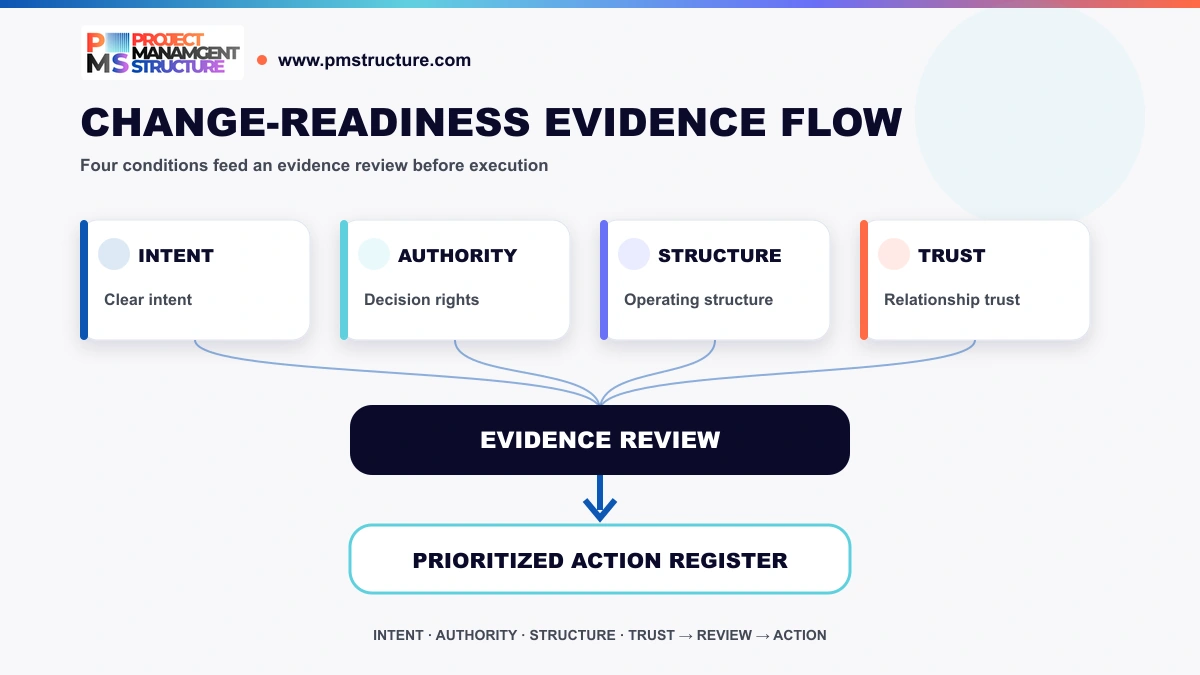
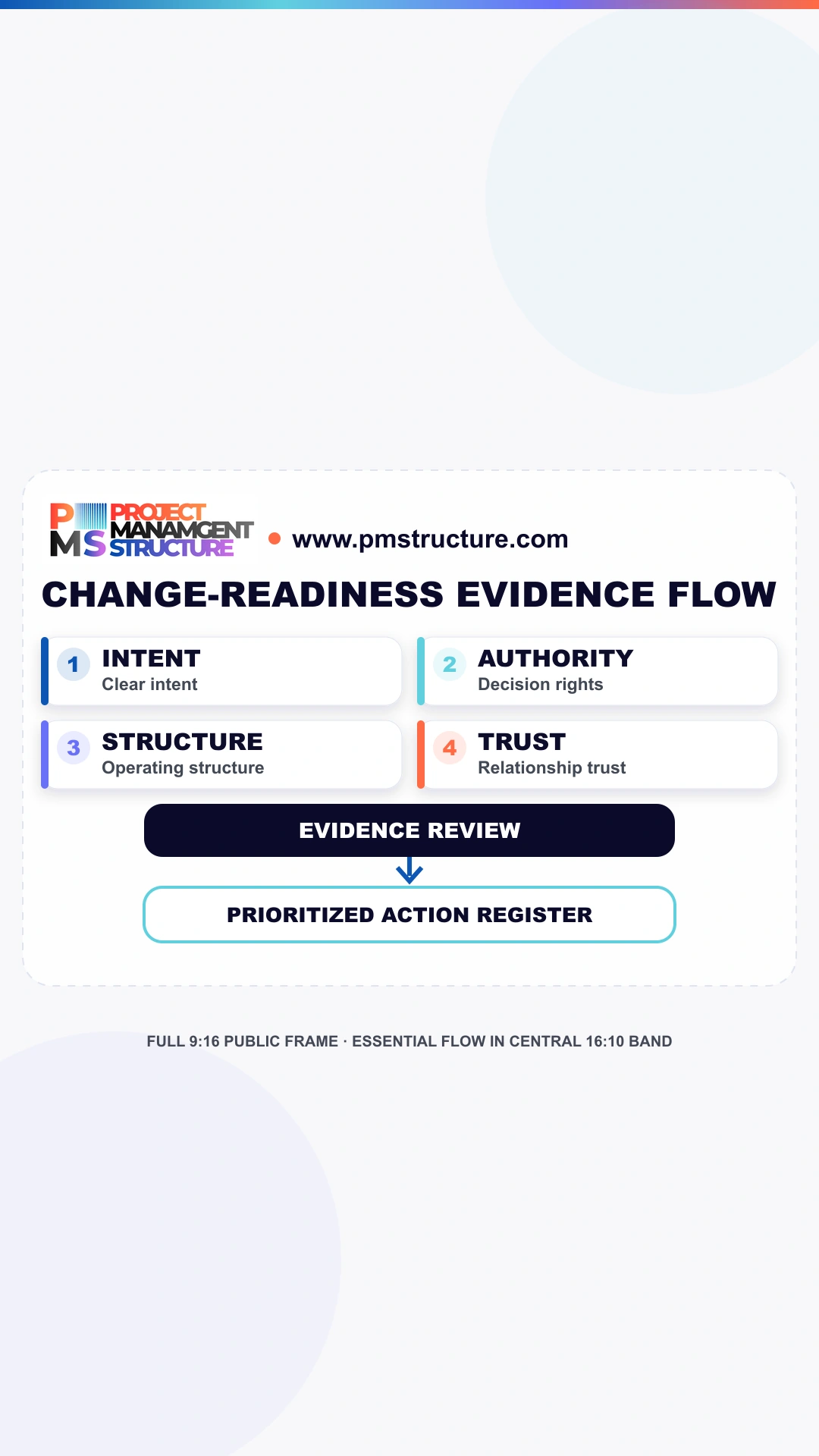
Use the four conditions as connected controls, not four independent scores.
| Condition | Core question | Minimum evidence before execution |
|---|---|---|
| Intent | Do people understand the outcome, reason, boundary and trade-offs of the change? | Outcome statement, value hypothesis, non-goals, decision constraints and evidence measures |
| Authority | Can decisions be made at the level where the necessary information and accountability exist? | Decision-rights map, guardrails, escalation triggers, named owners and response expectations |
| Structure | Does the operating design allow value, information, people and resources to move? | Dependency map, cross-functional ownership, capacity assumptions, funding/resource route and governance rhythm |
| Trust | Can people surface uncertainty, risks and contrary evidence without hiding or delaying them? | Visible risk route, challenge mechanism, learning review, no-retaliation expectation and evidence-based response |
The four conditions reinforce one another.
Clear intent without authority creates waiting. Authority without structure creates local decisions that cannot move through the wider system. Structure without trust produces a clean-looking process in which bad news travels slowly. Trust without intent can create energetic collaboration around conflicting outcomes.
Treat any missing connection as a readiness risk.
Condition 1: make intent executable
“Transform the customer experience” is an aspiration. It does not tell a product owner, project manager, operations lead or compliance reviewer what decision to make on Monday.
Executable intent contains five elements:
- Outcome: What should be different for the customer, organization or public?
- Reason: Why does that difference matter now?
- Boundary: What is included, excluded or deliberately unchanged?
- Trade-offs: Which constraints may move, and which obligations cannot?
- Evidence: What would show progress, harm or invalidation?
Write one paragraph that answers all five. Then ask three people from different levels to explain it in their own words. Do not grade whether they repeat the sponsor’s language. Check whether their decisions would point in the same direction.
If interpretations conflict, do not solve the problem with a longer slogan. Record the unresolved choice and assign an owner.
Condition 2: move authority with guardrails
Empowerment is not “teams can decide everything.” It is a designed relationship between authority, accountability and limits.
Create a small decision-rights map:
| Decision | Decides | Must be consulted | Guardrail | Escalation trigger |
|---|---|---|---|---|
| Prioritize the next service increment | Product or service owner | Delivery, operations, customer representative | Regulatory and approved funding boundaries | Material compliance, benefit or cross-program impact |
| Reallocate team capacity within the increment | Delivery lead | Functional managers | Minimum operational coverage | Capacity movement affects another committed outcome |
| Accept a material change to the target outcome | Sponsor or governance body | Product, finance, risk and affected operations | Business-case and mandatory-obligation review | Value case or public/customer commitment changes |
The names will vary by context. The control is the same: each recurring decision should have a home, a boundary and a trigger.
PMI and the Agile Alliance’s enterprise-agility manifesto describes governing with clear guardrails rather than gatekeepers and moving authority to where value is created. That does not remove governance. It makes governance explicit enough that a team can act without guessing whether a decision will later be reversed.
Condition 3: design structure for flow
Many transformation plans change reporting lines before they change how work moves.
Test structure through a real value path. Select one important outcome and trace it from need to decision to delivery to adoption. At each handoff, record:
- who owns the next action;
- what evidence they require;
- which queue or committee the work enters;
- what capacity assumption is being made;
- which dependency can stop progress;
- how a conflict is resolved.
This exposes structural friction that an organization chart will not show.
Look especially for:
- shared specialists assigned to several “top priorities”;
- funding locked to activities after evidence changes;
- approvals that duplicate an earlier review;
- local metrics that reward delay or functional optimization;
- work transferred without acceptance criteria;
- dependencies with no accountable integrator.
A structure designed for flow does not mean removing every control. It means controls are placed where they protect value, compliance, safety or informed commitment—and their cost is visible.
When the friction comes from predictive, agile and hybrid work meeting at the same governance boundary, use PM Structure’s guide to hybrid governance across predictive, agile and hybrid work as the companion interface check.
Condition 4: make trust observable
Trust is often discussed as culture and measured only through sentiment. For readiness, look for operating evidence.
Ask:
- When did someone last surface a material risk early?
- What happened to the person and the risk?
- Can a team challenge an assumption without challenging the sponsor’s legitimacy?
- Are estimates allowed to remain ranges when uncertainty is real?
- Does a learning review change a decision, process or resource allocation?
- Can suppliers and partners raise interface problems through a protected route?
If the official answer is “we encourage openness” but every difficult issue appears first as a late exception, trust is not yet supporting execution.
Create a simple challenge route. A person raising contrary evidence should know where it goes, who reviews it, when a response is due, and how the decision trail is retained. The route must protect confidentiality where required and must not replace legal, safety, HR or regulatory escalation.
Run the diagnostic in 45 minutes
The first pass should be short enough to reveal uncertainty rather than produce a polished fiction.
Invite the sponsor or delegate, delivery lead, one operational representative, and one person who owns a major dependency or control.
Step 1: state the change in one sentence
Use this form:
We intend to change ______ for ______ so that ______, while protecting ______.
If the group cannot complete it without argument, record the intent gap.
Step 2: answer four evidence questions
Give each condition ten minutes:
- What evidence shows this condition is ready?
- What evidence is missing or disputed?
- Which assumption are we treating as fact?
- What is the smallest action that would reduce the gap?
Do not score confidence. Link every answer to an artifact, decision, observation or named owner.
Step 3: use red, amber and green carefully
- Green: minimum evidence exists and the operating owner confirms it is usable.
- Amber: the gap is known, bounded and assigned, with a date or trigger.
- Red: the condition is missing, contradictory, ownerless or dependent on an unapproved assumption.
The colors are not a maturity rating. They are a start-decision aid for this change at this time.
Step 4: build one action register
| Gap | Condition | Consequence if ignored | Smallest corrective action | Owner | Evidence due | Start decision |
|---|---|---|---|---|---|---|
| Regional teams interpret the target outcome differently | Intent | Conflicting priorities and measures | Sponsor publishes non-goals and resolves two disputed trade-offs | Sponsor | 31 July | Hold affected work |
| Service owner cannot approve capacity movement | Authority | Repeated escalation and missed feedback window | Define a capacity guardrail and escalation threshold | Portfolio lead | 1 August | Start within current capacity only |
| Compliance reviewer enters after design | Structure | Rework and late obligation risk | Add reviewer to discovery and acceptance checkpoints | Program lead | Immediate | Conditional start |
| Supplier avoids raising interface risks | Trust | Hidden dependency failure | Establish protected interface-risk review with response time | Commercial lead | 2 August | Hold high-risk interface |
Every row should end in a decision: start, start with conditions, hold a bounded area, or escalate. “Monitor” is not enough unless the monitored signal and response trigger are explicit.
A hypothetical example
Consider a public-facing digital service program preparing to move from pilot to multi-region rollout.
The intent sounds clear: expand access and reduce processing delay. During the diagnostic, the team finds four different interpretations of “access,” including language support, mobile performance, assisted service and eligibility coverage.
Authority is also unclear. Regional operations can change staffing but cannot adjust the rollout sequence, even when local readiness evidence is weak. The central program office owns the schedule but receives operational data after the decision meeting.
The structure includes a risk committee, but the accessibility reviewer joins only at final acceptance. Trust appears strong within the delivery team, yet a supplier says interface risks are discussed privately because the commercial meeting treats every issue as a performance failure.
The correct response is not to label the whole program unready. It is to control the gaps:
- define the access outcomes and non-goals;
- move bounded sequencing authority closer to regional evidence;
- bring accessibility review into discovery and incremental acceptance;
- create a relationship-risk route separate from commercial blame.
This example is fictional. Its purpose is to show how the four conditions convert a vague readiness concern into accountable work.
Common mistakes
Mistake 1: treating communication as intent
A town hall can distribute a message. It does not prove that people can apply the trade-offs. Test decisions, not recall.
Mistake 2: delegating tasks instead of authority
A team may own delivery activities while every meaningful choice remains centralized. Map decisions and guardrails separately from responsibilities.
Mistake 3: using a reorganization as evidence of flow
New boxes and reporting lines do not prove that dependencies, resources or approvals move differently. Trace a real value path.
Mistake 4: measuring trust only through agreement
A meeting with no disagreement may indicate alignment—or silence. Look for how contrary evidence is treated.
Mistake 5: turning the check into a pass/fail theatre
If leaders need every condition to appear green, the diagnostic will become another reporting artifact. The purpose is to expose and control gaps, not protect a launch narrative.
When to repeat the check
Repeat the four-condition review when:
- the outcome or external obligation changes;
- a new region, partner or operating unit joins;
- funding or capacity is materially reallocated;
- decision latency rises;
- the same risk appears late more than once;
- a learning review changes a core assumption;
- trust is damaged by blame, concealment or an unhandled concern.
Keep the evidence history. Readiness is time-bound, and a previous green condition can become amber when the context changes.
Frequently asked questions
Is this an agile maturity assessment?
No. It is a PM Structure start-readiness check derived from four conditions in PMI’s July 2026 research. It does not certify maturity or require a particular delivery framework.
Should every red condition stop the whole transformation?
Not automatically. Determine which outcomes and work areas the condition affects. A red compliance or safety issue may require an immediate hold or qualified escalation. A bounded authority gap may allow work inside an existing guardrail. Record the rationale.
Who should own the diagnostic?
The sponsor owns the decision to proceed, but the evidence must include people who understand delivery, operations and major dependencies. A PMO can facilitate without becoming the owner of every corrective action.
Can the check replace formal governance?
No. Use it to improve the evidence entering governance. It does not replace contractual, regulatory, legal, safety, financial or organizational controls.
Next action
Choose one active change—not the entire enterprise—and run the four-condition check against its next material commitment. If the team cannot point to evidence for intent, authority, structure and trust, add the missing control before adding another layer of activity.
If you need a structured review of the decision rights, evidence and governance rhythm around a transformation, request a PM Structure governance review. The purpose is to clarify the operating gap and next decision, not to sell a predetermined framework.
References
- Project Management Institute. Closing the Change-Readiness Gap: What Gets Lost Between Strategy and Execution. July 2026.
- Project Management Institute and Agile Alliance. Manifesto for Enterprise Agility. Accessed 28 July 2026.

PM Structure Editorial Role
PMO & Transformation MentorA PM Structure editorial role covering PMO governance, transformation, portfolio delivery, and organisational capability.
View all articles by PMO & Transformation MentorThis article is editorial content from PM Structure. It does not replace official certification-body guidance. For pathway and readiness support, explore certifications.
Related Articles

Workplace Safety Basics Every Team Should Know
Infrastructure Relationship Governance: Five Questions to Answer Before Delivery Starts
PMI-RMP Eligibility: Separate Project Risk Experience From General Project Work
PMP or PMI-ACP in 2026? Choose by Work Evidence, Exam Scope and Career Direction
Stay ahead of the curve
Get weekly insights on certification strategy, agile leadership, and career growth.
View all articles