


PMP Renewal in 2026: Build an Audit-Ready 60-PDU Evidence System
A three-year PMP renewal evidence system for organizing 60 PDUs, Talent Triangle coverage, CCRS reporting, activity proof, transfer checks, and audit retention.
PMP renewal is easier to manage when professional development and evidence are treated as one system.
The problem is not always a lack of learning. A holder may complete courses, watch webinars, read, mentor, create content, or work as a practitioner, yet still reach the end of the cycle with unclear categories, missing dates, incomplete proof, Talent Triangle gaps, or activities that were never reconciled in CCRS.
The current official requirement for PMP is 60 professional development units across a three-year Continuing Certification Requirements cycle. But a total is not an evidence system.
An audit-ready system should record the activity when it occurs, classify it against the current PMP rules, store the type of proof that matches the activity, show whether it has been reported, and preserve the records for the required period. "Audit-ready" means organized evidence that matches what was reported. It does not mean audit-proof, automatically accepted, or guaranteed renewal.
The official rules belong to PMI. The board and checkpoint rhythm in this article are independent PM Structure tools for making gaps visible earlier.
Start with the current PMP renewal boundaries
PMI's current maintenance page and the Continuing Certification Requirements Handbook, marked last updated April 2026, establish the controlling requirements.
For PMP, the current cycle is three years and the total requirement is 60 PDUs:
- at least 35 must be Education PDUs;
- no more than 25 may come from Giving Back;
- within Education, at least 8 PDUs are required in Ways of Working;
- at least 8 are required in Power Skills;
- at least 8 are required in Business Acumen; and
- the remaining 11 Education PDUs may be earned in any Talent Triangle area.
The wording matters. Giving Back is a maximum, not a mandatory target. The three Talent Triangle amounts are minimums, not fixed totals. Requirements also differ across PMI credentials, so do not copy the PMP structure into a CAPM, PMI-ACP, PMI-RMP, or PMI-PMOCP plan without checking that credential's current rules.
PMI directs holders to report PDU activities through the Continuing Certification Requirements System. The handbook says holders are responsible for reporting activities as they occur. Your private evidence board should support that official process; it should not become an alternative record that is never reconciled.
Why evidence fails even when learning occurred
Evidence problems usually begin with a delay between the activity and the record.
A holder attends a course and keeps the completion email but does not record the date or Talent Triangle allocation. A useful webinar is reported months later from memory. Reading is entered without the title, author, dates, or notes. Practitioner work is treated as unlimited credit. A Giving Back activity is logged, but the proof does not match the activity description.
The weakness is not necessarily dishonesty. It is often poor record design.
A renewal folder containing random certificates can still be incomplete because different activities require different evidence. The April 2026 handbook gives activity-specific examples. Courses may use registration, completion, or attendance evidence. Some online, self-directed, or informal learning may need notes and dates. Content creation may require copies of publications or educational materials. Work as a practitioner may require proof of employment.
The system therefore needs two kinds of control:
- a structured record of what is being claimed; and
- supporting material appropriate to that claim.
Build the eight-field PDU evidence board
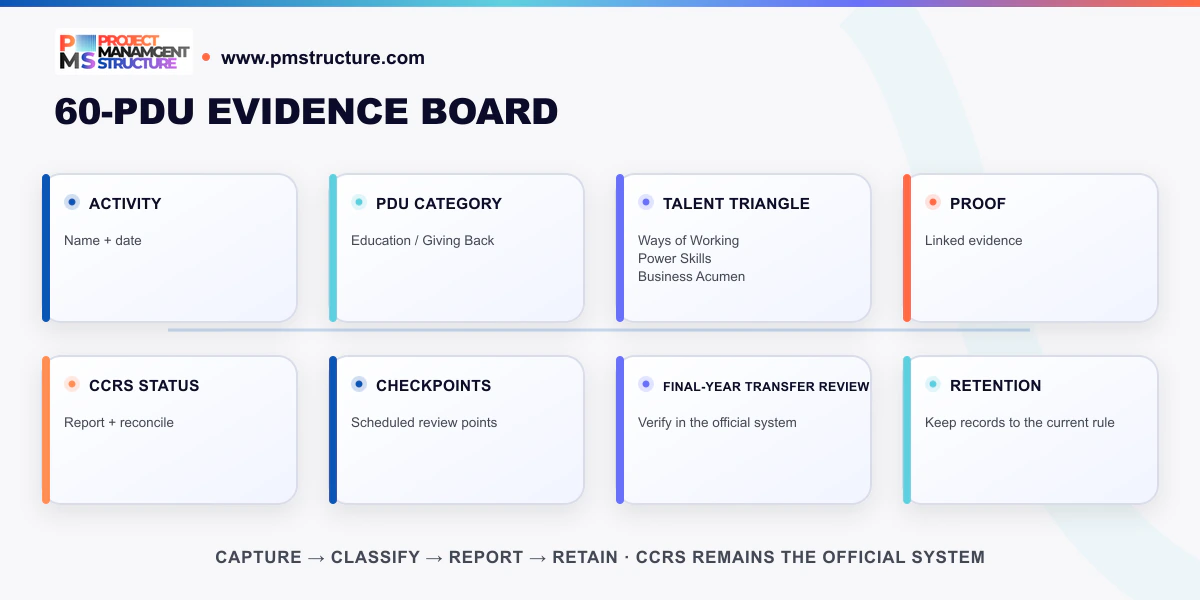 Desktop
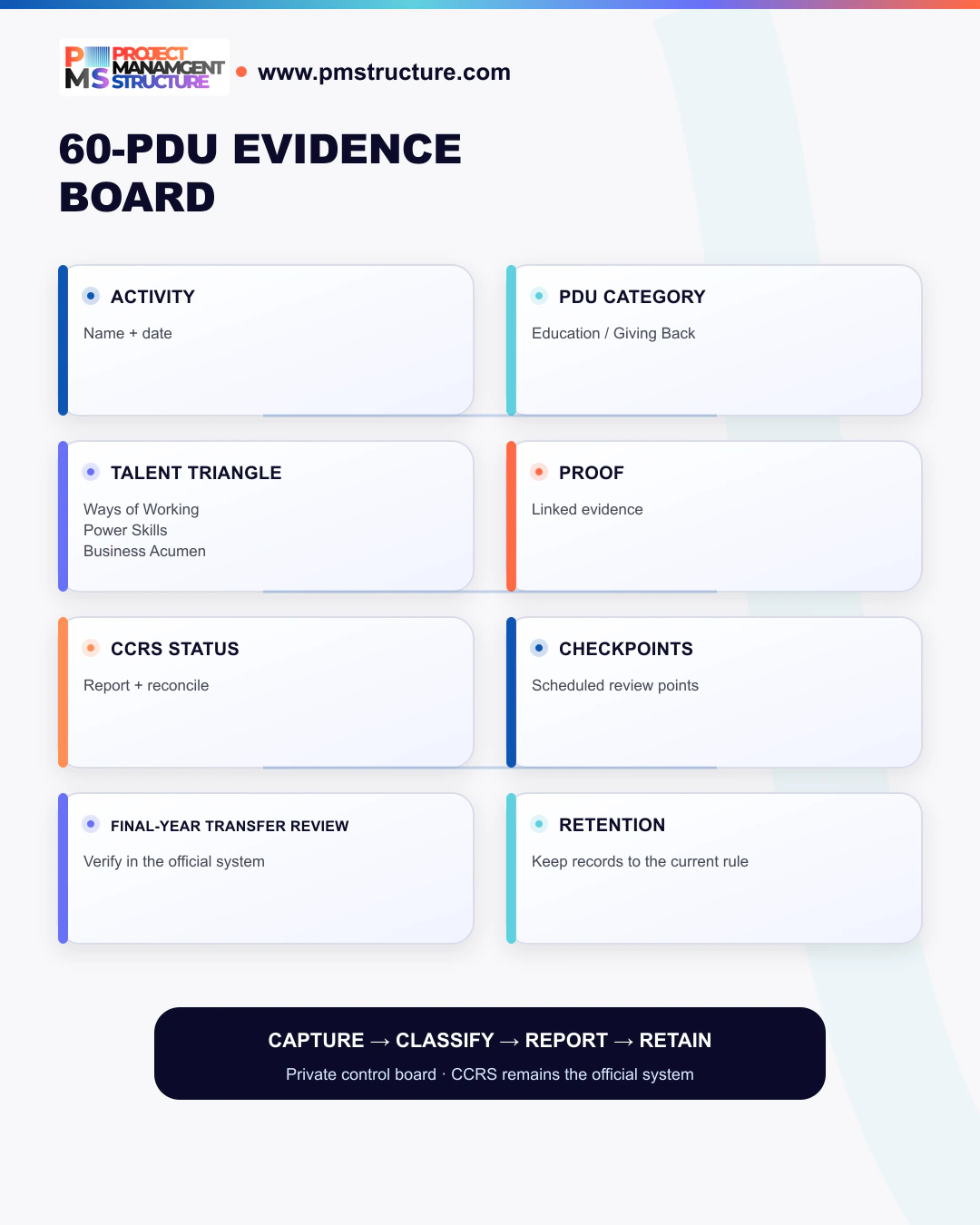 Mobile
Create one row for every activity. Use these eight fields.
| Field | What to record | Control question |
|---|---|---|
| Activity | Exact course, event, reading, mentoring, content, volunteering, or practitioner work | Can another reviewer identify what occurred? |
| Date and hours | Start/completion date and time being reported | Does the timing fall within the current cycle? |
| CCR category | Education or Giving Back, plus the specific activity type | Is the category supported by the current handbook? |
| Talent Triangle | Ways of Working, Power Skills, Business Acumen, or a justified split | Does the allocation match the learning content rather than the title alone? |
| Evidence | Certificate, attendance record, notes, publication copy, employment proof, or other matching support | Would the file support the activity description and hours? |
| CCRS status | Not reported, submitted, approved, returned, or needs review | Does the private board agree with the official system? |
| Source/version | Current PMI page or handbook version used for the decision | Can the rule be rechecked if it changes? |
| Checkpoint | Next review date and responsible holder | When will a gap be found and resolved? |
The board should link to a controlled folder rather than embed sensitive documents in a public or widely shared file. Use a consistent naming convention, for example:
YYYY-MM-DD_activity-provider_evidence-type
Do not place confidential employer information, personal identifiers, or credentials into an uncontrolled shared folder. Evidence should be accessible to the holder who is responsible for the claim and protected according to the organization's real records and privacy requirements.
Separate official status from your local status
Your board may say "submitted" because you entered an activity in CCRS. It should say "approved" only when the official system shows that state. Do not infer acceptance from a provider email, a local spreadsheet, or the fact that an activity appears eligible.
If an activity is returned or needs review, keep the original evidence and record the correction. Do not silently replace history.
Use four checkpoints across the three-year cycle
PMI does not require the checkpoint rhythm below. It is a PM Structure recommendation for controlling evidence.
1. Monthly capture
Once a month, add recently completed activity, link the evidence, and record the current CCRS state.
Ask:
- Is the activity described precisely?
- Are the dates and hours supported?
- Is the category plausible under the current handbook?
- Does the evidence file open?
- Has the activity been reported, or is there a reason to wait?
The aim is to reduce reliance on memory.
2. Quarterly allocation review
Every quarter, compare the board with the official PMP requirements.
Review:
- total Education PDUs;
- Ways of Working, Power Skills, and Business Acumen minimums;
- Giving Back totals and maximum;
- activities needing clarification;
- records present locally but missing from CCRS;
- CCRS entries that lack matching local evidence.
Do not chase the total alone. A holder can accumulate many Education PDUs while still leaving a Talent Triangle minimum incomplete.
3. Final-year transfer review
The handbook states that only excess PDUs earned in the final 12 months of the cycle can be applied to a future cycle. For PMP, the current transfer limit is up to 20 PDUs.
Record the activity date and current-cycle need before you label anything as potentially transferable. Transfer is not a reason to neglect the current requirements, and it should not be assumed to be automatic. Verify the official system and current rules.
Work as a practitioner has a separate boundary. For PMP, the current maximum is 8 PDUs per cycle. Those PDUs count within Giving Back and do not transfer to the next cycle.
4. Pre-renewal reconciliation
Before renewal, compare three surfaces:
- the official CCRS record;
- the evidence board; and
- the supporting files.
Resolve differences before treating the cycle as complete. Confirm that the required totals and minimums are satisfied, the activity records are accurate, the evidence opens, and the current renewal instructions have been rechecked.
Do not publish a fixed renewal fee in a long-lived plan. The handbook says renewal fees are subject to membership and regional pricing. Use the current myPMI renewal surface for the applicable amount.
Match evidence to the activity
A useful evidence system does not use one generic checklist for every claim.
Courses and training
Keep the registration record, completion certificate, or attendance letter that supports the reported activity. Confirm that the activity title, dates, provider, and hours align with the entry.
Online or digital learning
Record the provider, title, description, start/completion dates, and the Talent Triangle allocation being claimed. Retain notes and dates where the handbook calls for evidence of the learning conducted.
Reading
Record the author, title, description, and start/completion dates. Keep notes that show what was learned and why it is relevant to the credential.
Informal learning
For a structured discussion, mentoring session, panel, or lunch-and-learn, retain notes and dates. A calendar invitation alone may not explain what learning occurred.
Creating content
Keep a copy of the publication, educational material, course agenda, or other evidence matching the activity. A draft that was never completed should not be represented as a completed published contribution.
Work as a practitioner
Keep proof of employment and make sure the work is related to the certified role. Remember the PMP limit of 8 PDUs per cycle, its place within Giving Back, and the rule that these PDUs do not transfer.
These examples summarize the current handbook. The exact evidence requested in an audit is controlled by PMI, not by this article or by PM Structure.
A hypothetical three-year record
Consider a PMP holder named Omar. During the first year, he completes a leadership course, attends a technical webinar, reads a business-strategy paper, and begins mentoring a junior project professional.
His first record is a folder containing two certificates and several emails. It does not show which activity belongs to which category, whether the Talent Triangle allocation is supported, or whether the activity appears in CCRS.
Omar rebuilds the record:
| Activity | Category and allocation | Evidence | CCRS status | Next check |
|---|---|---|---|---|
| Leadership course | Education; proposed Power Skills allocation | Completion certificate, course outline, dates | Submitted | Confirm official status and allocation |
| Technical webinar | Education; proposed Ways of Working allocation | Attendance evidence and notes | Not reported | Validate hours and enter |
| Strategy paper | Education; proposed Business Acumen allocation | Citation, reading dates, notes | Needs review | Confirm relevance and reporting details |
| Mentoring | Giving Back; activity type to be verified | Session log and dated notes | Not reported | Check current handbook requirements |
This board does not prove that the activities will be accepted. It makes the missing decisions and evidence visible while there is still time to correct them.
At the quarterly review, Omar compares the board with CCRS. He does not count the same activity twice, does not assume Giving Back is required, and does not classify mentoring from the label alone. He rechecks the current handbook before reporting.
Common mistakes
Mistake 1: planning only for the total of 60
The total does not replace the Education minimum, Talent Triangle minimums, or Giving Back maximum.
Mistake 2: treating Giving Back as a requirement
The current PMP rule describes 25 Giving Back PDUs as a maximum. Do not build a plan that assumes all 25 must be earned.
Mistake 3: saving evidence without a matching record
A certificate in a folder is hard to use when it is not connected to the activity, dates, hours, category, CCRS entry, and review status.
Mistake 4: using the same proof for every activity
Evidence expectations vary. Match the support to the reported activity and the current handbook.
Mistake 5: assuming practitioner work is unlimited
For PMP, work as a practitioner is currently capped at 8 PDUs per cycle, counts within Giving Back, and does not transfer.
Mistake 6: treating the private board as the official record
The board supports control. CCRS remains the reporting system. Reconcile the two rather than assuming they match.
Mistake 7: deleting evidence when the cycle ends
PMI states that documentation for PDU claims should be kept for at least 18 months after the CCR cycle has ended. Another legal, employer, or contractual requirement may call for longer retention, so do not treat 18 months as an automatic deletion date.
Mistake 8: claiming to be audit-proof
PMI states that all certification holders are subject to audit and that a percentage is randomly selected. Organized evidence can make your records easier to retrieve; it cannot prevent selection or guarantee the result.
Frequently asked questions
How many PDUs are required for PMP renewal?
The current requirement is 60 PDUs over a three-year cycle, with at least 35 Education PDUs and no more than 25 Giving Back PDUs.
Are Giving Back PDUs mandatory?
No. The current PMP structure sets a maximum of 25 Giving Back PDUs. It does not require a holder to earn all 25.
How long should I keep PDU evidence?
PMI's April 2026 handbook says to keep documentation for all PDU claims for at least 18 months after the CCR cycle ends. Retain records longer when another legitimate requirement applies.
Can excess PMP PDUs transfer?
Only excess PDUs earned in the final 12 months of the current cycle may be applied to a future cycle. The current PMP limit is up to 20. Verify the actual transfer in the official system.
Can work as a practitioner supply all Giving Back PDUs?
No. For PMP, work as a practitioner is currently capped at 8 PDUs per cycle. It counts within Giving Back and does not transfer.
Does PM Structure approve PDUs or renewal?
No. PMI controls CCR requirements, PDU decisions, audits, and renewal. PM Structure can help a professional organize a development plan and evidence, but it cannot award or approve PDUs or guarantee renewal.
Next action
Create one evidence-board row for the most recent activity in your current cycle. Link the supporting file, classify the activity against the current handbook, record the CCRS state, and set the next review date. Then reconcile the rest of the cycle one activity at a time.
If you want to connect continuing development with a structured PMP pathway, review your PMP development path. PM Structure provides independent preparation and professional-development support; it does not issue the PMP credential, approve PDUs, control audits, or guarantee renewal.
References
- Project Management Institute. Maintain Your Certification. Accessed 28 July 2026.
- Project Management Institute. Continuing Certification Requirements Handbook. Last updated April 2026; accessed 28 July 2026.

PM Structure Editorial Role
PMP Readiness MentorA PM Structure editorial role providing source-reviewed guidance on PMP readiness, exam preparation, and study planning.
View all articles by PMP Readiness MentorThis article is editorial content from PM Structure. It does not replace official certification-body guidance. For pathway and readiness support, explore certifications.
Related Articles

Before You Book Live PMP Training: What PMI’s Late-Q4-2026 Eligibility Change Means

Build a PMP Scenario Practice Operating System, Not a Question Habit
PMP 2026 Official Reference List: Build a Study Source Map Without Reading Everything

Business Environment Is Now 26%: A Practice Plan for the Updated PMP Exam
Stay ahead of the curve
Get weekly insights on certification strategy, agile leadership, and career growth.
View all articles