


PMI-RMP 2026 Domain Map: Turn Five Exam Domains Into an Evidence-Led Study Plan
A practical five-domain PMI-RMP study map linking risk strategy, identification, analysis, response, monitoring and closure to decisions, artifacts and corrective evidence.
Risk tools are easier to remember when they are treated as isolated definitions. Real risk decisions are not isolated.
A threshold comes from context and appetite. A useful risk statement connects a cause, uncertain event and effect. Analysis should help a decision, not simply produce a number. A response needs an owner and a trigger. Monitoring should test whether the response is working and whether the exposure has changed.
That connected logic is the central preparation challenge.
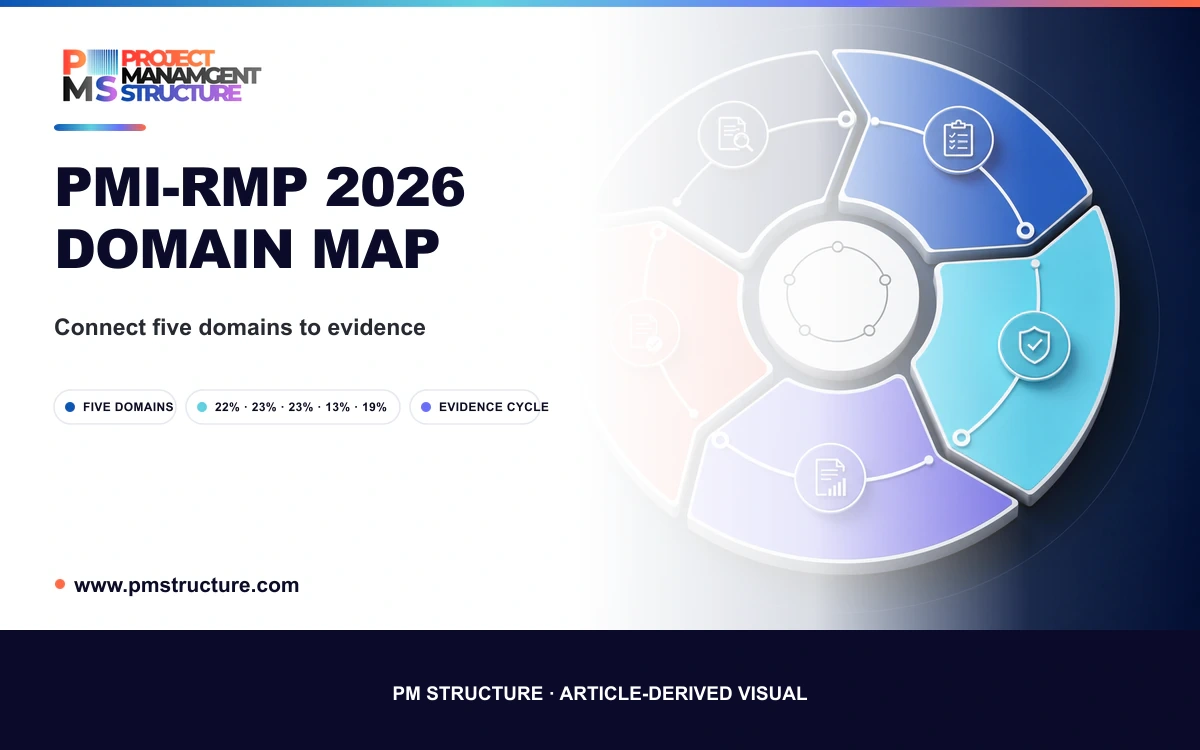
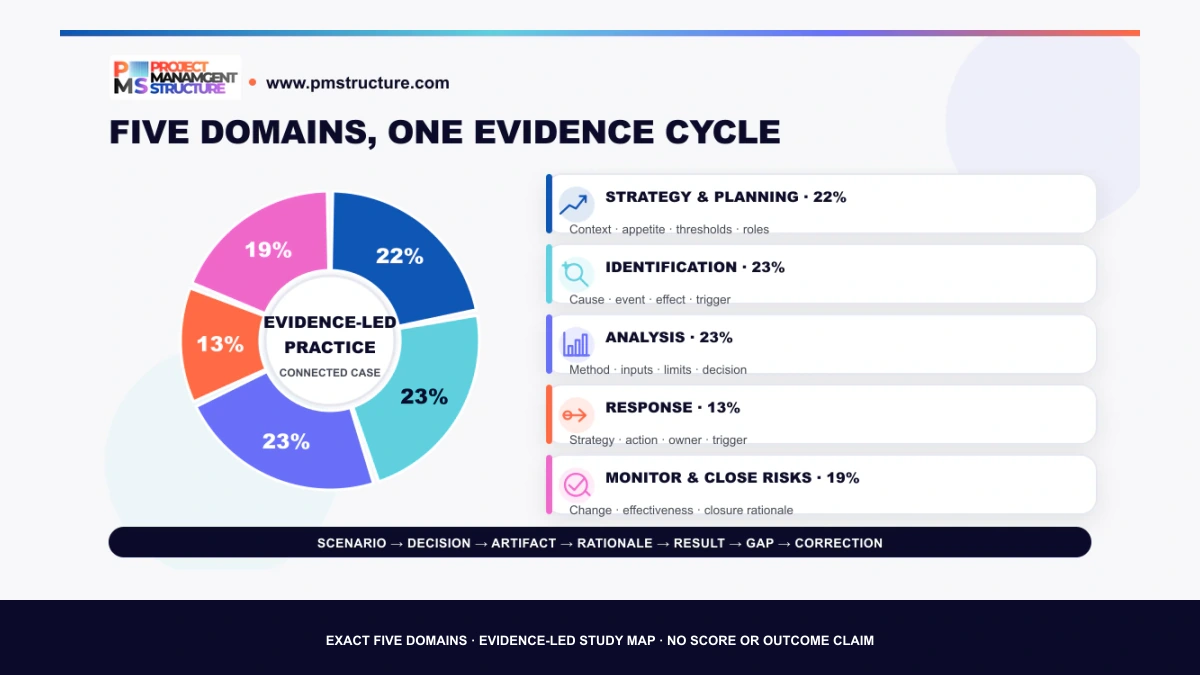
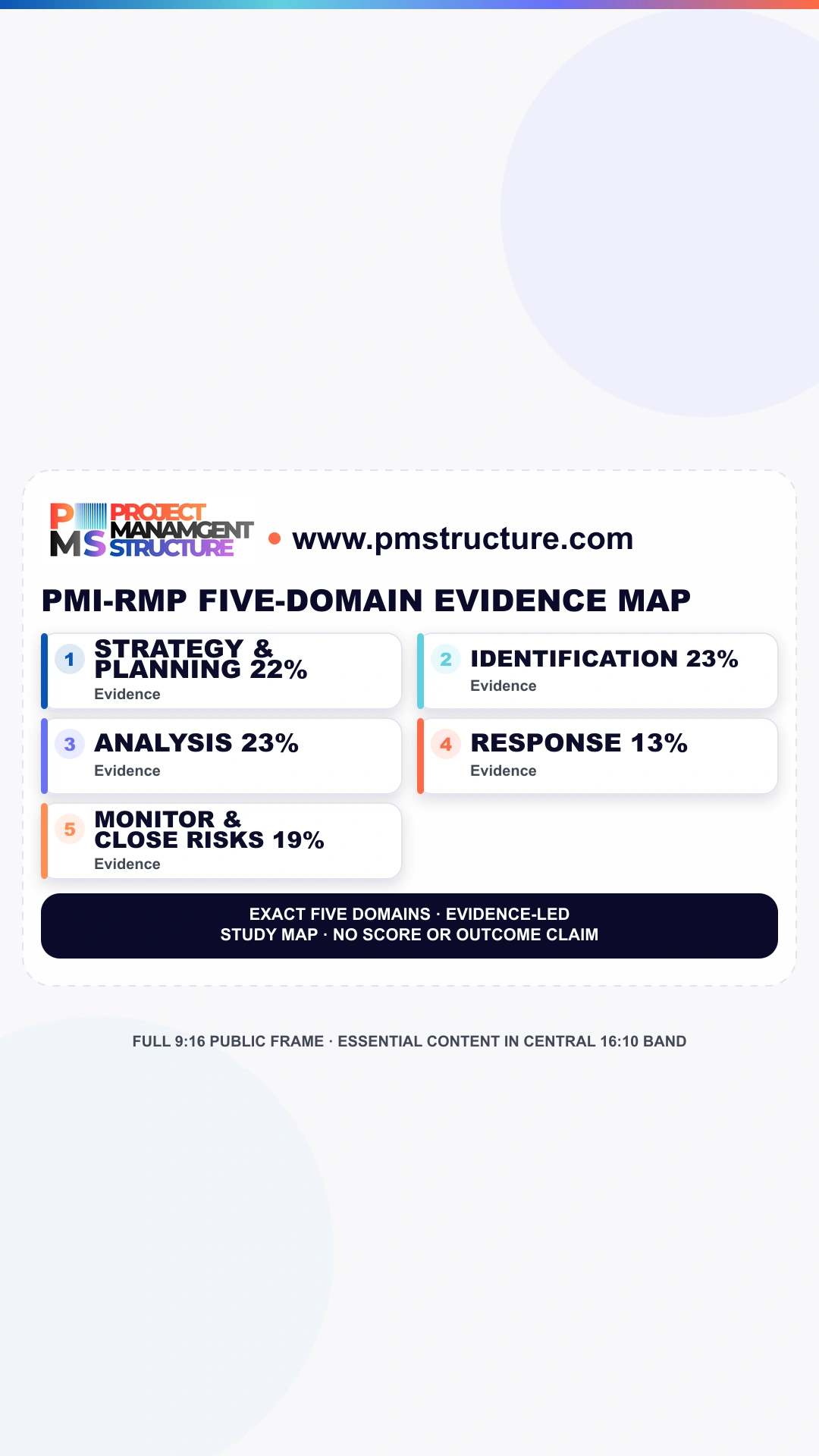
The current PMI Risk Management Professional (PMI-RMP) blueprint has five domains: Risk Strategy and Planning, Risk Identification, Risk Analysis, Risk Response, and Monitor and Close Risks. A responsible study plan should not turn those labels into five unrelated folders. It should help you follow evidence and decisions across the whole risk cycle.
This article gives you a five-domain evidence ledger for doing that. It is an independent PM Structure study method. It does not calculate a readiness score, predict an exam result or reproduce live exam questions.
Start with the current blueprint
PMI's current PMI-RMP certification page and the official PMI-RMP Examination Content Outline present the same five domain proportions:
| Domain | Published proportion |
|---|---|
| Risk Strategy and Planning | 22% |
| Risk Identification | 23% |
| Risk Analysis | 23% |
| Risk Response | 13% |
| Monitor and Close Risks | 19% |
| Total | 100% |
These percentages describe the exam blueprint at domain level. They do not reveal a universal study-time split, a passing threshold or a personal readiness score.
The outline also says predictive, agile and hybrid approaches can appear throughout the five domains. They are not confined to one domain or task. That matters because a candidate can know a risk technique but still struggle to adapt the technique to the project's delivery approach, information quality, decision cadence or stakeholder environment.
One freshness detail is worth making explicit. The current official outline is labelled as an update from January 2023, while the public certification page continues to present the same five-domain blueprint in July 2026. “2026” in this article describes the current preparation context. It does not mean PMI issued a new 2026 examination outline.
Why weights are not a study schedule
It is tempting to allocate study time by multiplying the percentages. For example, a candidate might assign 23% of available time to identification and another 23% to analysis.
That looks precise but ignores the candidate's actual evidence.
One candidate may identify risks well but fail to connect them to appetite, thresholds and project objectives. Another may perform qualitative analysis accurately but choose a response without testing whether the action addresses the analyzed exposure. A third may understand response strategies yet forget to define monitoring evidence.
The blueprint tells you what is covered. Your practice evidence should tell you where to work next.
Use the percentages to prevent neglect. Use observed errors to set the sequence and depth of practice.
Treat the five domains as a decision cycle
The domain order can support a useful learning narrative, but it should not be mistaken for a rigid process that every project must follow identically.
Risk Strategy and Planning
This domain establishes the decision environment. The official outline includes document and environmental analysis, appetite and threshold alignment, strategy, the risk management plan, roles, prioritization criteria, communication and stakeholder engagement.
The study question is not only “What is risk appetite?” It is:
How would context, appetite, constraints and stakeholder expectations change the risk approach and the decisions it supports?
Evidence may include a short strategy rationale, threshold explanation, responsibility map or communication choice.
Risk Identification
Identification is more than producing a list. The outline includes identification exercises, assumption and constraint analysis, triggers and thresholds, and development of the risk register.
Good practice distinguishes:
- a source or cause;
- an uncertain event;
- a possible effect on objectives;
- a trigger or warning sign;
- a relevant owner;
- whether the uncertainty is a threat, opportunity or both depending on context.
If every practice entry is a vague concern such as “supplier risk” or “schedule problem,” the weakness is not quantity. It is the structure and decision usefulness of the record.
Risk Analysis
The outline covers qualitative and quantitative analysis and identification of threats and opportunities against project objectives and governance.
The important preparation question is:
What decision should this analysis inform, and why does the selected method fit the available information?
A probability-impact matrix may support prioritization when agreed scales and definitions exist. A more quantitative technique may support another decision when data and consequences justify it. The article is not prescribing one technique for every project. The evidence should show that you can connect the method to purpose, inputs, assumptions and limitations.
Risk Response
The response domain includes planning, assigning time-bound actions and ownership, implementing responses and considering effectiveness.
A response record should answer:
- Which exposure is being addressed?
- Which response strategy is being used?
- What action will be taken?
- Who owns the action and the risk?
- What trigger activates a contingency?
- What evidence will show whether the response changed the exposure?
Memorizing “avoid, mitigate, transfer and accept” without building that connection leaves the decision incomplete.
Monitor and Close Risks
Risk work does not stop when an action is assigned. The outline includes monitoring responses, emerging, secondary and residual risks, updating information and lessons, monitoring project risk levels and communicating them.
Monitoring evidence should show what changed:
- exposure increased or decreased;
- a trigger occurred;
- a response was completed but ineffective;
- a secondary risk appeared;
- an assumption became invalid;
- the risk expired or can be closed with a reason;
- the decision needs escalation or revision.
Closure should be supported by current evidence, not by the desire to reduce the number of open entries.
Build the five-domain evidence ledger
 Desktop
 Mobile
Create one row for each practice case. Keep the case connected across the domains.
| Field | What to record |
|---|---|
| Scenario and objective | Project context, delivery approach and objective at risk |
| Domain/task | Current domain and the task or responsibility being practised |
| Decision | What someone must decide now |
| Artifact/evidence | Plan, register entry, analysis, response, monitoring note or closure rationale |
| Rationale | Why the action or method fits the context |
| Result | Expected or observed effect on the decision/exposure |
| Gap | Missing information, weak assumption, wrong distinction or unsupported calculation |
| Correction | What will be changed and tested next |
Use the five domains as linked lenses:
| Domain | Evidence prompt | Weak-link action |
|---|---|---|
| Strategy and Planning | Can I connect context, appetite, thresholds, roles and communication? | Rebuild the logic from business driver to risk approach |
| Identification | Can I separate cause, event, effect, trigger and ownership? | Rewrite the risk statement and challenge assumptions |
| Analysis | Can I select and explain an analysis fit for the decision and data? | State purpose, inputs, limitations and decision effect |
| Response | Can I connect strategy, action, owner, trigger and effectiveness evidence? | Trace the response back to analyzed exposure |
| Monitor and Close | Can I show what changed and why the risk remains open, changes or closes? | Define the evidence and decision cadence |
The ledger does not need a numeric score. Use evidence states:
- Explain: I can state the concept and boundary.
- Distinguish: I can separate it from a tempting alternative.
- Apply: I can use it in a scenario.
- Evidence: I can show the rationale, artifact and correction.
- Recheck: the source, rule or assumption needs current verification.
These are PM Structure review labels, not official PMI proficiency levels.
Trace one hypothetical case across all five domains
Consider a hypothetical software migration with a fixed regulatory deadline. A specialist vendor is responsible for a critical data-conversion component.
Strategy and Planning evidence
The team records the regulatory deadline, the organization's tolerance for data-quality failures, decision rights, escalation thresholds and communication cadence. The candidate explains why a quality-related threshold may require earlier escalation than a cost variance of the same apparent size.
Identification evidence
Instead of writing “vendor delay,” the candidate records a more useful uncertainty:
Because the vendor's test environment has limited production-like data, conversion defects may be discovered late, which could delay validation and threaten the regulatory cutover date.
Possible triggers include missed data-profiling milestones, unresolved defect trends or failed reconciliation checks.
Analysis evidence
The candidate assesses probability, impact and urgency using the project's agreed scales, then explains the limitations of the available defect data. If a quantitative technique is considered, the candidate states which decision it would support and whether the inputs are defensible.
Response evidence
The response includes earlier representative-data testing, a named action owner, milestone dates, a contingency for an alternate conversion path and a trigger for escalation. The candidate explains how each action addresses the identified cause or reduces its effect.
Monitoring and closure evidence
The team reviews reconciliation results and defect trends at defined checkpoints. A completed test is not treated as proof that the risk is closed. Closure requires evidence that the exposure has fallen within the agreed threshold or that the uncertainty can no longer affect the objective.
This example does not establish one correct response. It shows how a single case can reveal whether the five domains are connected in your reasoning.
Diagnose the weak link
When a practice answer fails, do not immediately add more reading.
Ask:
- Did I misunderstand the domain concept?
- Did I confuse a cause, event, impact, trigger, threshold or response?
- Did I choose a technique without a decision purpose?
- Did I ignore the delivery approach or stakeholder environment?
- Did I create an artifact without showing how it changes a decision?
- Did I stop at response planning and omit monitoring evidence?
Classify the error before choosing remediation:
- Source gap: return to the relevant official task or authoritative explanation.
- Distinction gap: compare two near alternatives using one scenario.
- Application gap: practise a decision with explicit rationale.
- Evidence gap: produce or interpret the relevant artifact.
- Connection gap: trace the same case through an earlier or later domain.
- Freshness gap: re-open the current official source.
The correction should be smaller and more specific than “study risk analysis again.”
Use a weekly control
Review the ledger once each week or at another stable cadence that fits your plan.
Choose:
- one domain being neglected;
- one repeated error pattern;
- one connected case to trace;
- one artifact or rationale to improve;
- one official-source recheck if the information is time-sensitive.
Close a practice row “for now” only when you can explain the concept, distinguish it, apply it in context and evidence the reasoning. “Closed for now” is a study decision, not a claim that the domain is mastered.
Common mistakes
Memorizing tools without a decision
Knowing the formula or technique name is not enough. State what the analysis should help someone decide.
Treating the register as the risk system
The register is one artifact. It does not replace strategy, analysis, response ownership, monitoring or communication.
Ignoring opportunities
The outline addresses threats and opportunities. Practise both without forcing positive or negative language where the context does not support it.
Using domain weights as confidence scores
The published percentages describe the blueprint, not your capability. Use practice evidence to diagnose your gap.
Treating the risk standard as the exam outline
PMI's risk-management standard page provides important practice context. The Examination Content Outline remains the controlling blueprint for the domains and tasks. The outline also explains that its role study was not bound by that standard.
Ending at response assignment
Define what will be monitored, how effectiveness will be judged and when the decision will be revisited.
Frequently asked questions
What are the five current PMI-RMP domains?
They are Risk Strategy and Planning, Risk Identification, Risk Analysis, Risk Response, and Monitor and Close Risks. Recheck the current official page before relying on a saved list.
Should study time match the domain percentages?
Not automatically. The percentages protect coverage at blueprint level. Your observed errors and evidence gaps should determine where additional practice is needed.
Does the risk-management standard replace the exam outline?
No. It is a relevant practice reference, while the current PMI-RMP Examination Content Outline defines the exam domains, tasks and blueprint proportions.
Do I need a numerical readiness score?
No responsible score can be derived from domain weights alone. Evidence states and repeated scenario performance can support planning, but this article does not predict an exam result.
How do I repair a weak domain?
Diagnose whether the gap is knowledge, distinction, application, evidence, connection or freshness. Then use one targeted source or scenario to test the correction.
Next action
Choose one risk scenario from your work, training or ethical practice set. Trace it through the five domains. Record the decision, evidence, rationale, gap and correction at each step. If the reasoning breaks between domains, work on that connection before adding more tools.
If you want a structured credential pathway around official sources, scenario practice and evidence review, build your PMI-RMP readiness plan. PM Structure provides independent preparation support; it does not issue the credential, determine eligibility, disclose exam questions or guarantee an outcome.
References
- Project Management Institute. PMI Risk Management Professional. Accessed 29 July 2026.
- Project Management Institute. PMI-RMP Examination Content Outline. Accessed 29 July 2026.
- Project Management Institute. The Standard for Risk Management in Portfolios, Programs, and Projects. Accessed 29 July 2026.

Founder & Project Management Mentor
Sheikh M. AbdullahSheikh M. Abdullah leads PM Structure with practical guidance on project management certification, exam strategy, and delivery leadership.
View all articles by Sheikh M. AbdullahThis article is editorial content from PM Structure. It does not replace official certification-body guidance. For pathway and readiness support, explore certifications.
Related Articles
PMP Renewal in 2026: Build an Audit-Ready 60-PDU Evidence System

Workplace Safety Basics Every Team Should Know
PMI-RMP Eligibility: Separate Project Risk Experience From General Project Work
PMP 2026 Official Reference List: Build a Study Source Map Without Reading Everything
Stay ahead of the curve
Get weekly insights on certification strategy, agile leadership, and career growth.
View all articles